

Wine cellars, designed around the collection
A wine cellar is one of the most individual things OLBC builds apart from perhaps a bespoke dressing room. It has to hold a particular collection, at the right temperature and humidity, in a way that suits how its owner actually uses their wine: it should be a room worth showing guests, not simply a store.
Wine cellars are a specialism of OLBC’s Managing Director, Marc Stchedroff, who is consulted nationally on their design and construction. OLBC builds them two ways: fitted into an existing basement, or as a new basement built for the purpose.
Speak to a Director about a wine cellar
Why build a wine cellar at home
A collection of any size has to be kept somewhere stable — a steady temperature, the right humidity, low light, no vibration. For most collectors that has meant professional storage: an ongoing cost, and a collection held somewhere they cannot reach. Choosing a bottle for the table means ordering it days ahead.
A cellar at home ends both problems. The wine is kept in conditions designed around both the cate and display of the collection itself, and it is in the house — available the moment it is wanted. It also stops being a cost centre in a warehouse and becomes a room: somewhere to choose a bottle, show the collection, and enjoy it.
Wine is to be shared and enjoyed.

Passive or active
Every wine cellar is one of two kinds, and the choice shapes everything that follows.
Passive. A passive cellar uses the naturally stable temperature of the surrounding ground to hold the wine, with no mechanical cooling. There is nothing to run, nothing to service and nothing to fail — and no noise. The trade-off is control: the cellar sits at whatever temperature the ground and the building give it, so a passive cellar has to be designed around the conditions actually available below the house.
Active. An active cellar is a well-insulated room cooled by dedicated air-conditioning chiller units. It holds a precise temperature and humidity year-round, whatever the ground does, which makes it the more predictable choice for a serious collection. The trade-off is the reverse: there is equipment to run, to maintain, and to protect against failure.
Which one suits a particular house depends on the ground, the depth available, the size of the collection and how the owner wants to use it. Because OLBC designs and builds the basement as well as the cellar within it, that decision is taken with the structure and the conditions known — not assumed.
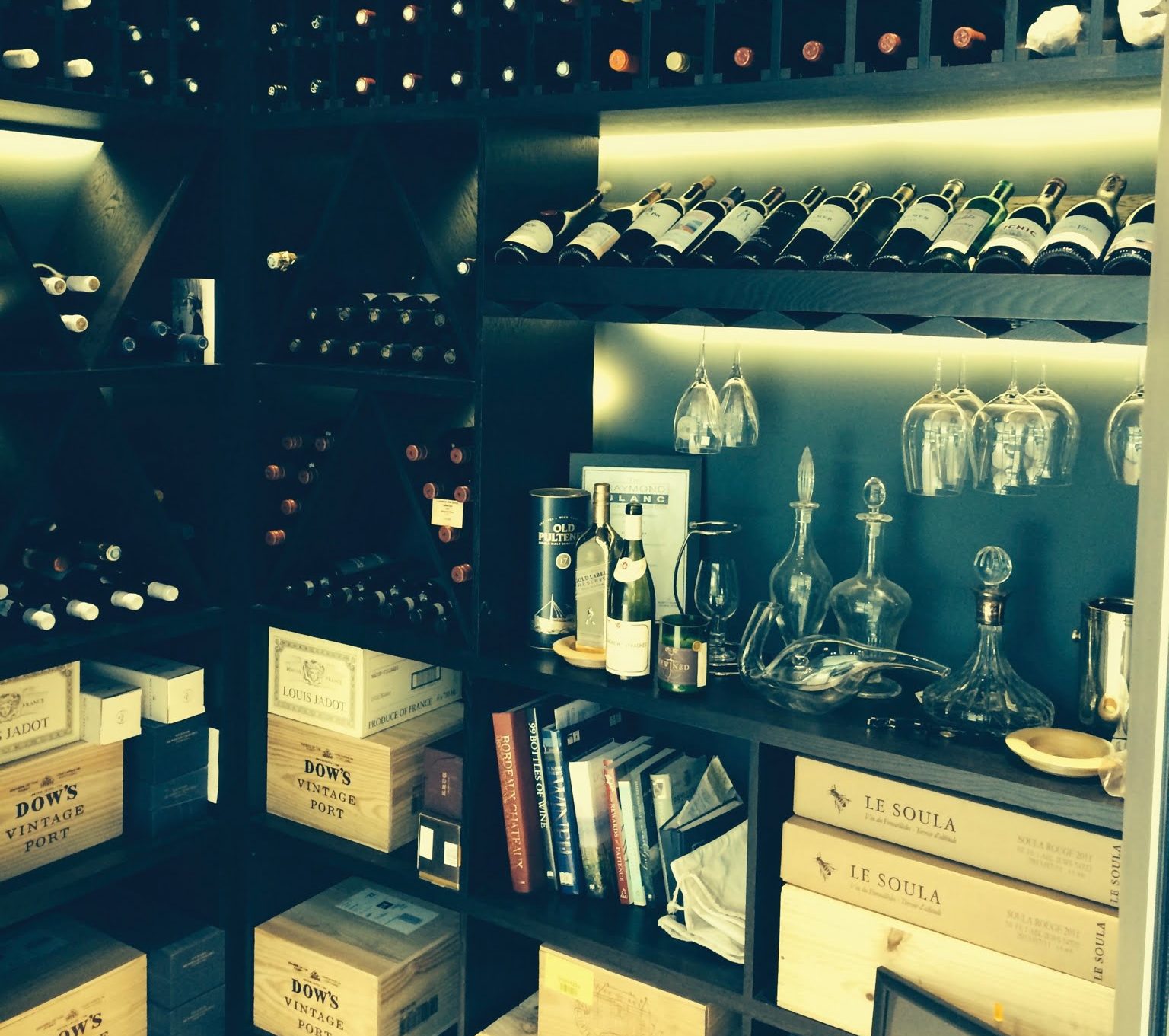
Racking: six ways to hold a collection
How the wine is racked is as much a design decision as a practical one. OLBC works in six systems, often combined within one cellar:
Wood. The most common choice: bespoke joinery-grade timber racking, set out for box, bin and individual-bottle storage according to the bottle types the collection holds.
Glass. Bonded glass shelving is a display statement in its own right. It pairs well with a double-glazed viewing wall into the cellar or wine room.
Metal display. Effective for display racking — bottles presented rather than simply stored.
Metal utility. A cost-effective, quick-to-build solution for a large cellar, or for a back room holding everyday drinking wine and bottles not yet ready. The workhorse behind the display.
York stone. The traditional solution. The stone is heavy, so it adds thermal mass, and porous, so it helps stabilise humidity — useful as well as handsome.
Concrete. Concrete stacking systems, long used in Europe, suit large cellars and an industrial look. Their thermal mass makes them well suited to a passive cellar — the winemaker’s cave — though they take up space, so they are less suited to a modest wine room.
Every wine cellar starts with a Director
The first conversation about a wine cellar is with one of OLBC’s Directors, not a sales desk. Tell us about the collection and the house — its size and how it is likely to grow, the space you have or the basement you are considering, and whether you lean towards a passive or an active cellar — and we’ll be honest about what is possible. A Director will be in touch within one working day.
Or email hello@olbc.co.uk, or message us on WhatsApp.
For mainstream basement conversions on London family homes — cost guidance, planning FAQs, basement design and construction — see our sister company London Basement Solutions.