

George Dines (1812–1887) was one of Thomas Cubitt’s most senior foremen and, from 1860, his successor at the Thames Bank works on Grosvenor Road, Pimlico. The son of a gamekeeper murdered by poachers in 1815, he entered Cubitt’s employment through the connection between the Whitbread family and Cubitt, carried out work at Osborne House, and from 1862 built the Royal Mausoleum at Frogmore for Queen Victoria. This page sets out the evidence for his life and career from Bedfordshire Archives, contemporary newspapers and journals, the census, the records of the Office of Works, and the Thomas Cubitt & Co letter books and lease books at The London Archives, through to the sale of the plant at the works in 1876 and his death at Hersham in 1887.
Contents
- Family and childhood
- Pimlico, Dorking, Wandsworth and Surbiton
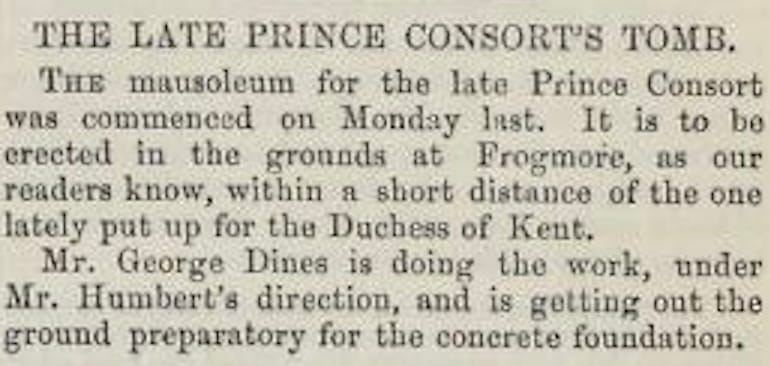
- The Royal Mausoleum, Frogmore, 1862
- The Thomas Cubitt & Co letter books
- The partnership with John Banderet
- The sale of the plant, 1876
- Later life and death
- Other possible family links
- Further reading
- Notes
Family and childhood
George Dines was born near Hitchin, Hertfordshire, in 1812.1 His father, Charles Dines, was a gamekeeper. In November 1812, the year of George’s birth, he was serving at Knebworth, a few miles from Hitchin, as a letter from W. Wilshere to Samuel Whitbread of 8 November 1812 records:2
“….will order Dines to attend. He is park-keeper as well as gamekeeper at Knebworth…”
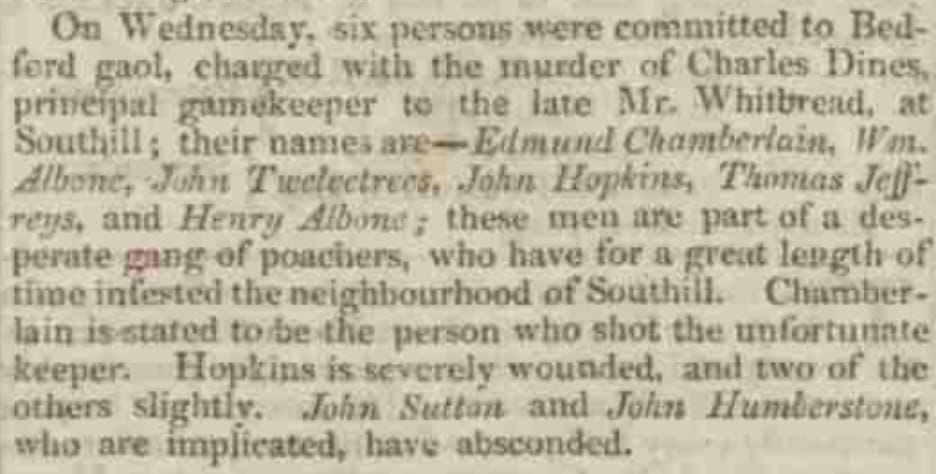
By 1815 he was gamekeeper to the Whitbread family at Southill, Bedfordshire, where he was shot and killed by poachers in December of that year, when George was three years old. The Whitbread family is said to have looked after the young boy, and it was through the connection between the Whitbread family and Thomas Cubitt that George found a position with Thomas Cubitt’s company. The suspects were named in press reports of December 1815 as Edmund Chamberlain, Wm. Albone, John Twel[?]trees, John Hopkins, Thomas Jeffreys and Henry Albone, with John Humberstone and John Sutton having absconded.
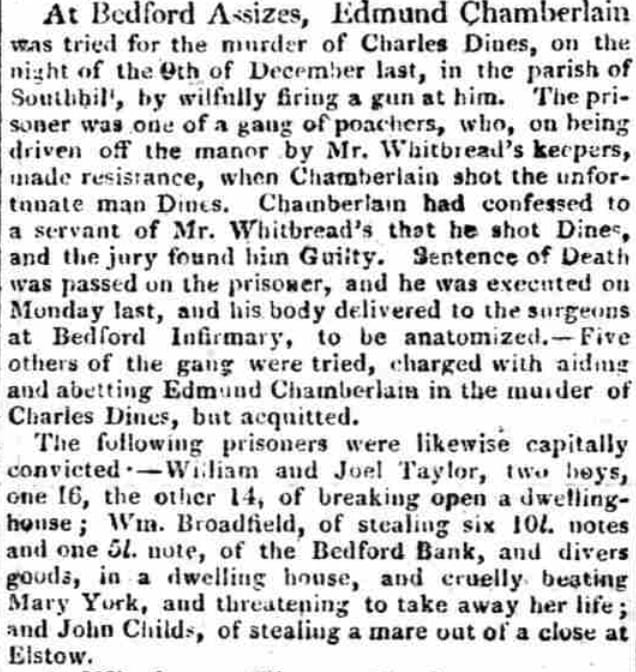
Edmund Chamberlain was convicted of the murder at Bedford Assizes in March 1816 and sentenced to death.
William Henry Whitbread’s will of 9 October 1863 contains a bequest of £60 to Harriet, a daughter of Charles Dines, which indicates that Charles was valued by the Whitbread family and that his descendants were provided for:3
“Harriet Button, widow of Southill, the daughter of my gamekeeper Charles Dines who was murdered in 1815 £60”
Pimlico, Dorking, Wandsworth and Surbiton
George Dines was one of Cubitt’s most senior foremen. He is often described as being “of Pimlico”, and for much of his time with Cubitt he lived there, close to the Thames Bank works. In 1852 Thomas Cubitt granted him a lease of a house in Charlwood Street, Pimlico, which he surrendered to Cubitt’s executors in 1856 (MDR 1852/16/731; MDR 1856/6/818). The 1851 census has George Dines living in Dorking, close to Denbies.

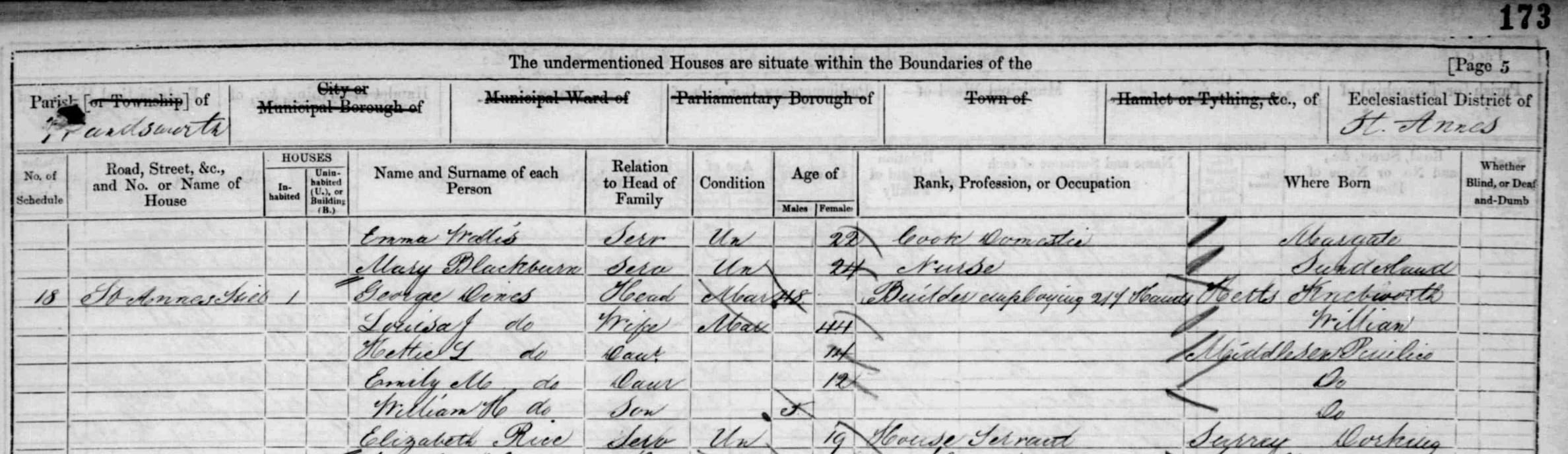
George Dines took over part of Cubitt’s Thames Bank works from Cubitt’s executors in June 1860. The 1861 census has George Dines at St Anne’s Hill, Wandsworth. The property was probably destroyed by enemy action during the Second World War.
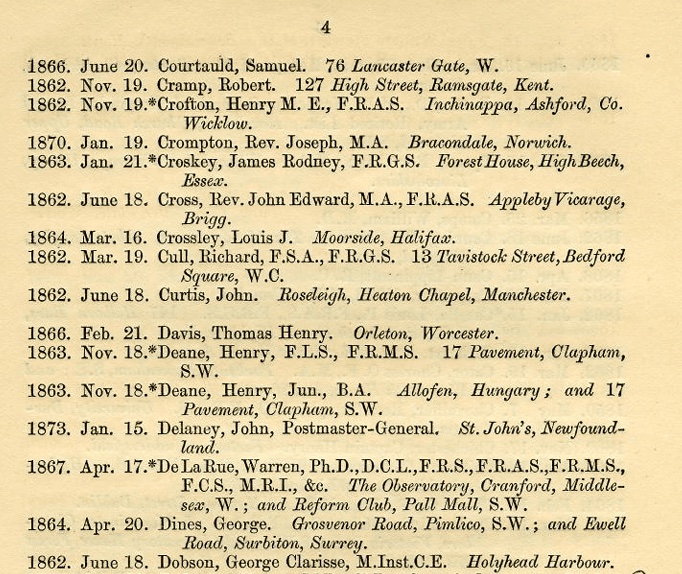
In a list of members of the British Meteorological Society published in 1864, Dines’ address is given as Grosvenor Road, which is the former Thomas Cubitt & Co works.
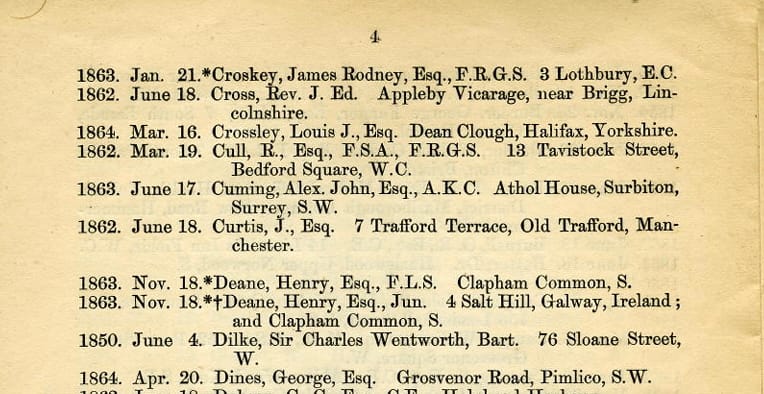
By 1873 the British Meteorological Society’s list of Fellows gives Dines’ addresses as Ewell Road, Surbiton, as well as Grosvenor Road, Pimlico. Ewell Road, Surbiton, is not an obvious choice of residence for a wealthy man who could live where he pleased. The move may have been Dines’ counterpart to Thomas Cubitt’s move to Clapham, or Dines may have been continuing the development of the Surbiton land that Cubitt appears to have bought; neither possibility has yet been established.
The Royal Mausoleum, Frogmore, 1862
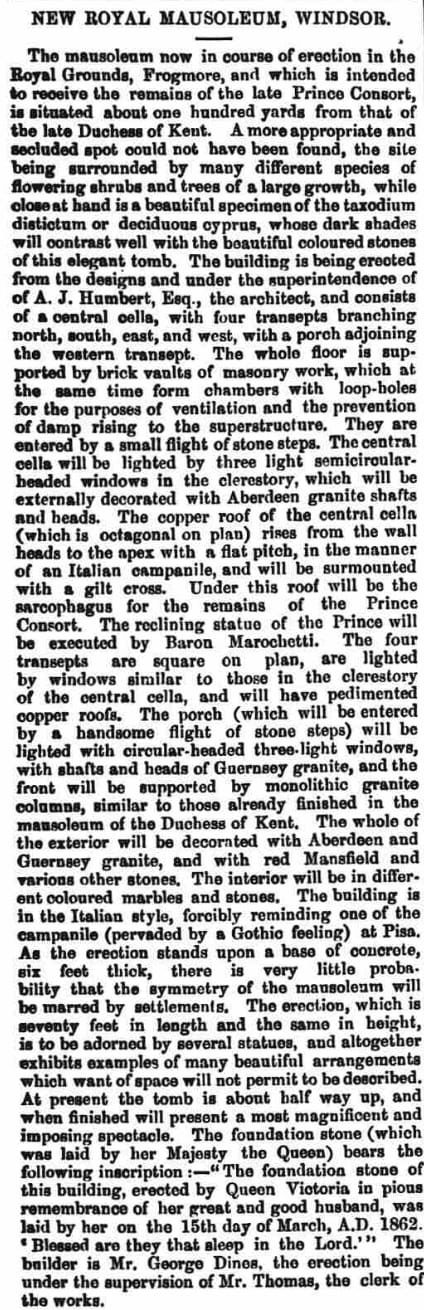
George Dines’ most prestigious commission, and an indication of the regard in which he was held by Queen Victoria, was the building of the Royal Mausoleum at Frogmore, designed by A. J. Humbert, under the supervision of Mr Thomas [Clerk of Works]. The pace of construction was rapid: The Builder of 1 February 1862 reports the foundations being dug, and press reports date the consecration to December 1862.


Records of the mausoleum
Records of the Frogmore Mausoleum at The National Archives include:
- WORK 19/33/1.
- WORK 34/911: Windsor Castle: Frogmore. Plans, elevations, sections and details of entrance gateway to Royal Mausoleum. Scale: 1 inch to 4 feet. Signed contract drawings by A. Humbert, Architect, 1865. With a written specification of works.
- WORK 34/908, 909 and 910: Windsor Castle: Frogmore. Plans, elevations and sections of new lodge at approach to Royal Mausoleum. Scale: 1 inch to 4 feet. Signed by A. Humbert, 1868. Stamped: Office of Works. With written specification of works.
- COPY 1/7/994: Photograph of the Prince Consort’s Mausoleum, Frogmore. Views of entrance and steps. No copy of photograph(s)/artwork(s) annexed.
The Historic England Archive also holds material relating to the mausoleum.
The Thomas Cubitt & Co letter books
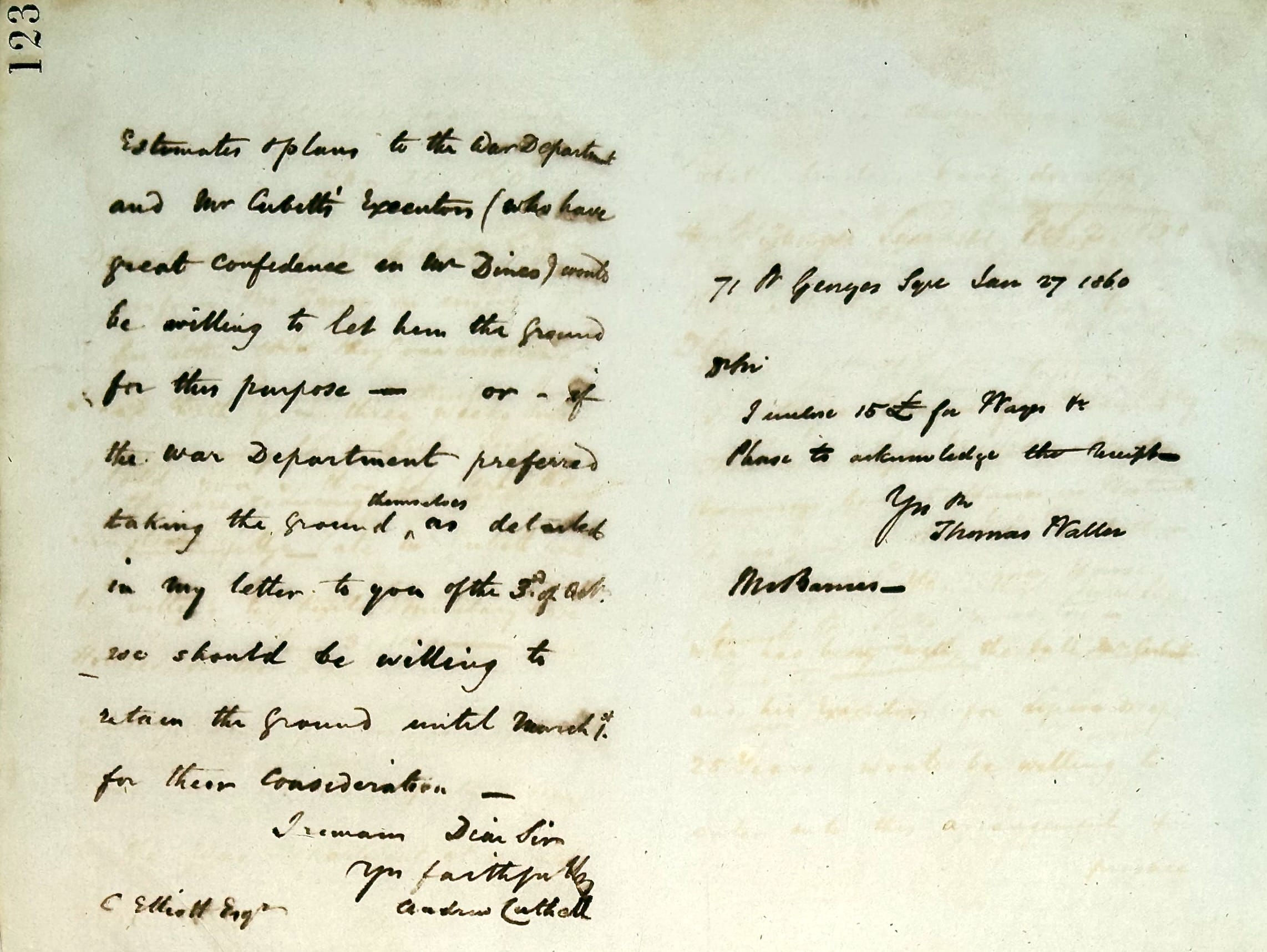
The Thomas Cubitt & Co wet copy letter books at The London Archives contain correspondence addressed to Dines, and concerning Dines and the Thames Bank works, particularly in the period when part of the works and part of the wharf were leased to the War Office. The images from the letter books below have been digitally enhanced and sharpened to make them more legible.
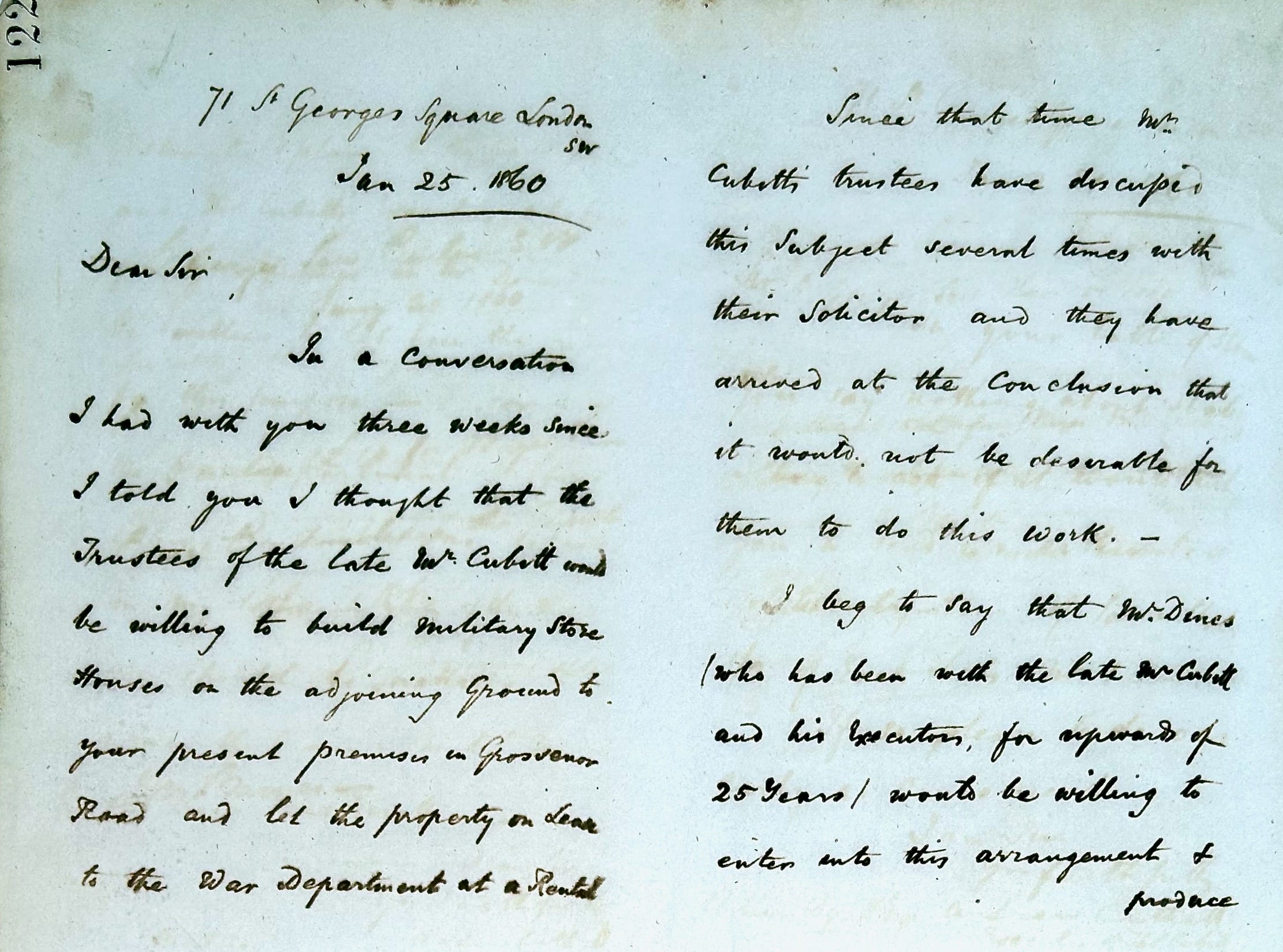
In a letter to C. Elliot Esq. dated 25 January 1860, Andrew Cuthell states that:4
“Mr Dines (who has been with the late Mr Cubitt and his Executors for upwards of 25 years) would be willing to enter into this arrangement.”
This dates Dines’ engagement by Thomas Cubitt to before 1835, which agrees with other, unreferenced, sources. The general purpose of the letter is to recommend that the War Department engage George Dines to build its new storehouse and factory on part of the former Thomas Cubitt & Co site.
A letter from Andrew Cuthell to Dines of 12 November 1861 asks:5
“I find a Stone Merchant is looking at our Wharf (next yours) do you think it likely that the Government will want it”

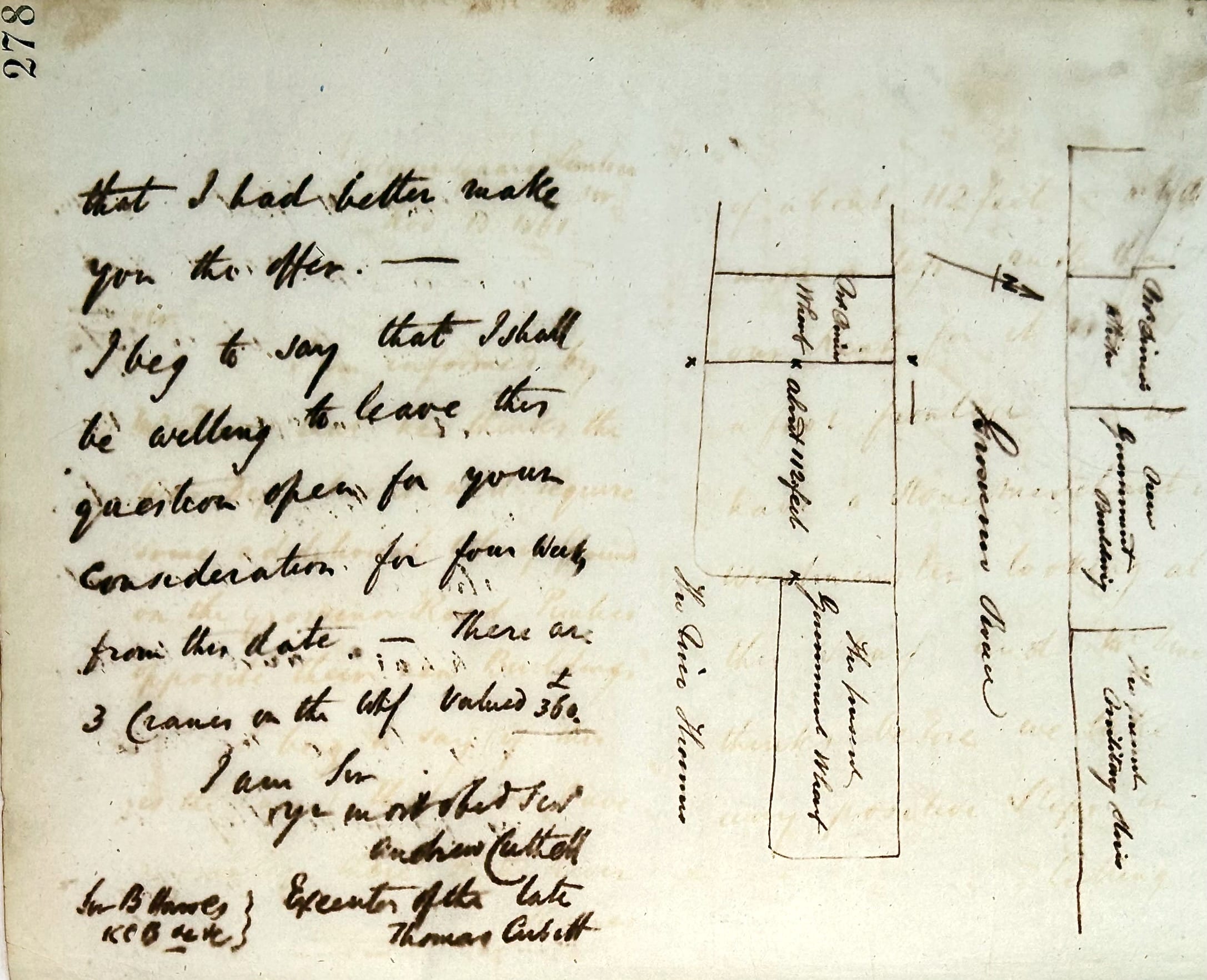
In a letter of November 1861 Andrew Cuthell writes:6
“I am informed by Mr Dines that he thinks the War Department will require some additional Wharf Ground on the Grosvenor Road Pimlico opposite their new Buildings”
The letter contains a sketch of the layout of the works and wharves around Grosvenor Road.

Andrew Cuthell’s letter of 22 January 1862 refers specifically to the use of:7
“marble lying on our wharf…by order of his R. H. [Royal Highness, Prince Albert] the late Prince Consort – some [of] this has now been used by Mr Dines for Pedestals for Osborne”
This shows that Dines was carrying out works at Osborne for Queen Victoria in the 1860s.

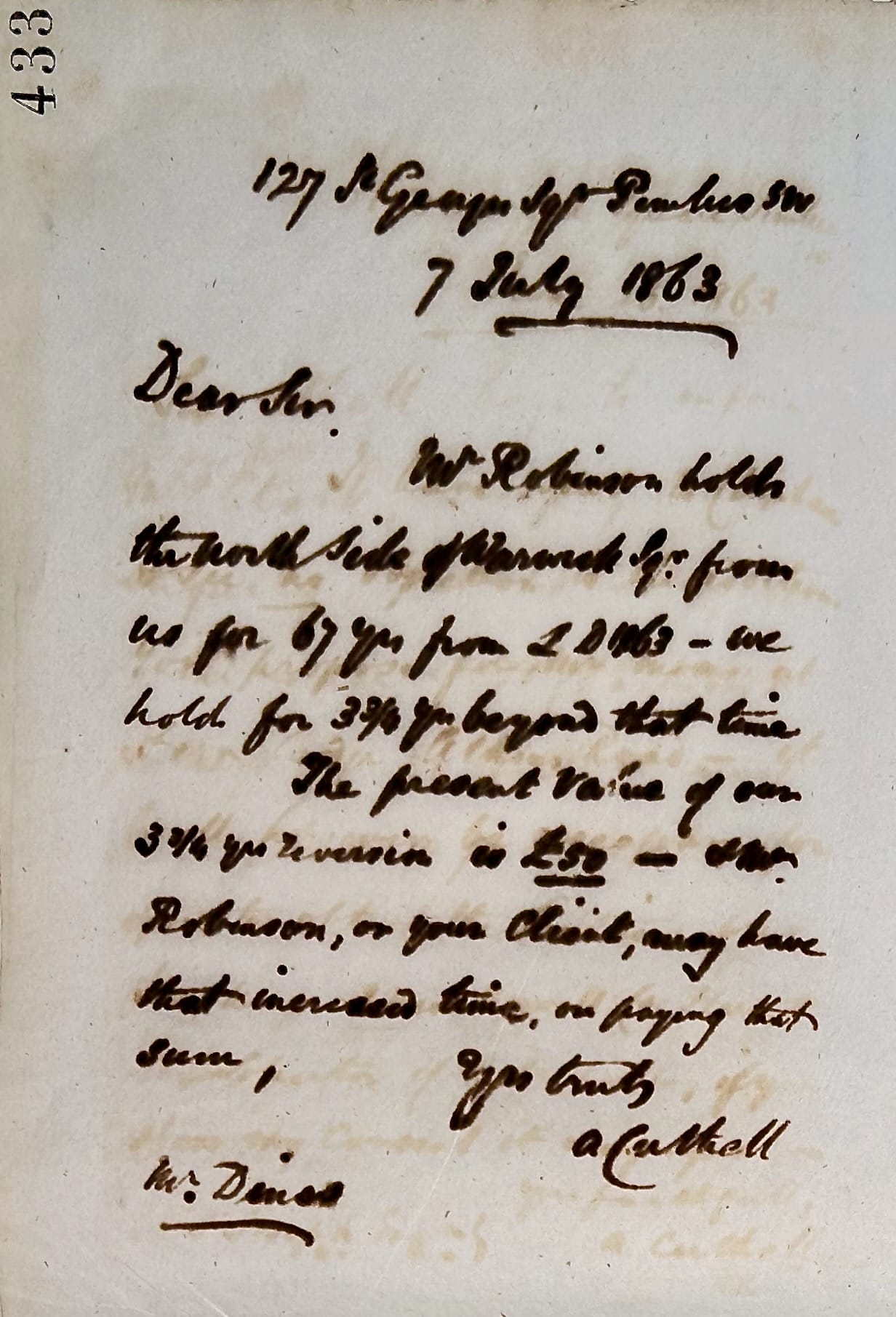
The letter of 7 July 1863 appears to be a reply to a request from Dines for further building land in Pimlico. It states that:8
“Mr Robinson holds the north side of Warwick Sqr. from us for 67 years….”
The partnership with John Banderet
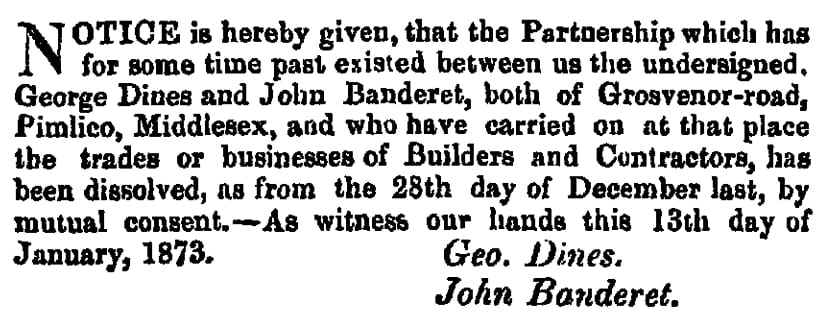
The Gazette of 14 January 1873 carried notice of the dissolution, as from 28 December 1872, of the partnership between George Dines and John Banderet.
The sale of the plant, 1876
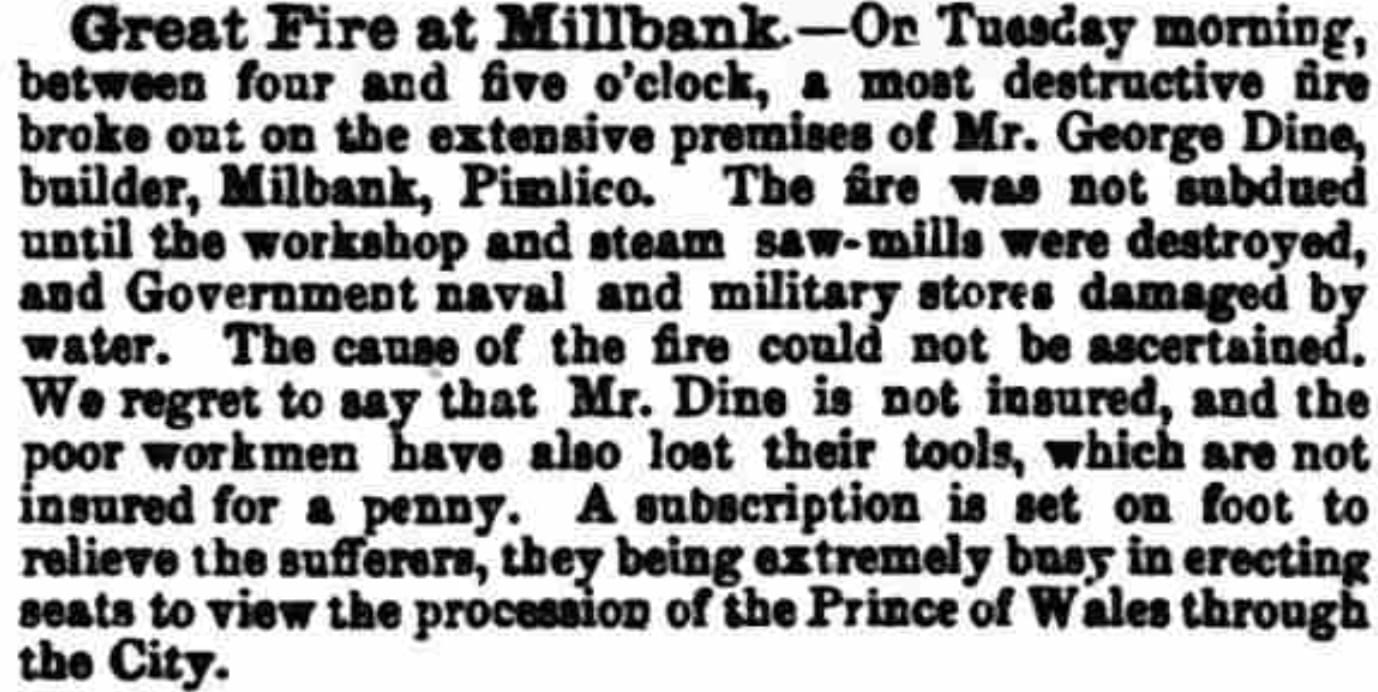
Dines continued to use the Thames Bank works until he retired in 1876, when the plant, machinery and stock of the workshops were auctioned by Fuller, Horsey, Son & Co.9 Hobhouse asserts that the auction catalogue gives an insight into the likely configuration of the works in Cubitt’s time. However, there were a number of serious fires at the works, among them in 1854 (the year before Cubitt died) and in 1863 (during George Dines’ tenure). Press reports of the 1863 fire state that “the workshop and steam saw-mills were destroyed”. It is therefore not clear how most of Thomas Cubitt & Co’s equipment could have survived to be auctioned in 1876, unless the press reports are not wholly accurate.
Later life and death
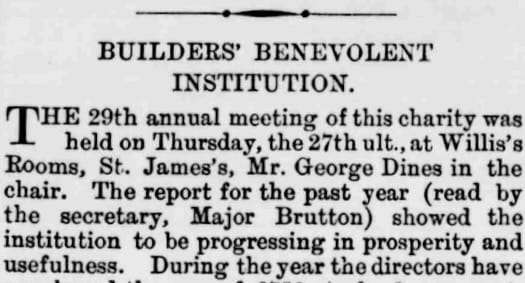
Dines was active in the Builders’ Benevolent Institution, chairing its annual meeting in 1876.
Woodside, Hersham, 1875
A nineteenth-century watercolour by Emily Dines, sold at auction by Cheffins, is described in the sale catalogue as:10
“View of the east front of the house and grounds known as ‘Woodside’ or ‘Burlea’, Hersham, built in 1875 by George Dines, general foreman to Thomas Cubitt, builder to Queen Victoria, watercolour, together with ‘Dial Stone’, the news sheet of Walton and Weybridge Local History Society dated Oct/Nov. 1972, detailing the history of the property”
George Dines died on 25 May 1887 at his home in Hersham. He was buried at St Peter’s, Hersham, where in 1892 his widow, Louisa Sarah née Coke, was buried with him.11
Other possible family links
The meteorologist William Henry Dines (1855–1927) was George Dines’ son.12 No relationship has been established with John Henry Dines, builder, of 12 Woburn Buildings, Woburn Place, who appears both in the Thomas Cubitt & Co lease book for the Bedford Estate and in a Sun Insurance policy of 17 November 1830.13

Further reading
- Ranmore War Memorial: George Dines.
- Pike, W. (2005), ‘William Henry Dines (1855–1927)’, Weather, 60: 308–315. https://doi.org/10.1256/wea.38.05
Notes
1 Information from the Ranmore War Memorial site: https://ranmorewarmemorial.info/st-barnabas-church/george-dines/
2 Letter from W. Wilshere to Samuel Whitbread, 8 November 1812. Bedfordshire Archives, W1/5159.
3 Will of William Henry Whitbread, 9 October 1863. Bedfordshire Archives, W3527.
4 Andrew Cuthell to C. Elliot Esq., 25 January 1860. Thomas Cubitt & Co wet copy letter book. The London Archives, LA/4608/01/01/006, pp. 122–123.
5 Andrew Cuthell to Mr Dines, 12 November 1861. Thomas Cubitt & Co wet copy letter book. The London Archives, LA/4608/01/01/006, p. 276.
6 Andrew Cuthell to Sir B. Hawes KCB, 13 November 1861. Thomas Cubitt & Co wet copy letter book. The London Archives, LA/4608/01/01/006, pp. 277–278.
7 Andrew Cuthell to Sir C. B. Phipps KCB, 22 January 1862. Thomas Cubitt & Co wet copy letter book. The London Archives, LA/4608/01/01/006, p. 298.
8 Andrew Cuthell to Mr Dines, 7 July 1863. Thomas Cubitt & Co wet copy letter book. The London Archives, LA/4608/01/01/006, p. 433.
9 The auction catalogue of 1876 by Fuller, Horsey is referred to on the Ranmore War Memorial site (see note 1).
10 Cheffins, Fine Art, lot 40, Emily Dines (19th century): https://fineart.cheffins.co.uk/auction/lot/lot-40—emily-dines-19th-century/?lot=196275&sd=1
11 Information from the Ranmore War Memorial site (see note 1).
12 See the appreciation of William Henry Dines in Pike, W. (2005), ‘William Henry Dines (1855–1927)’, Weather, 60: 308–315, https://doi.org/10.1256/wea.38.05.
13 Thomas Cubitt & Co lease book, Bedford Estate volume, The London Archives, LA/4608/01/02/002, p. 336; Sun Insurance policy register, The London Archives, MS 11936/523/1115234, 17 November 1830.
Discuss your project with OLBC
Working on a listed building or a prime London property? Tell us about it.