

The Russell Institution
& Thomas Cubitt
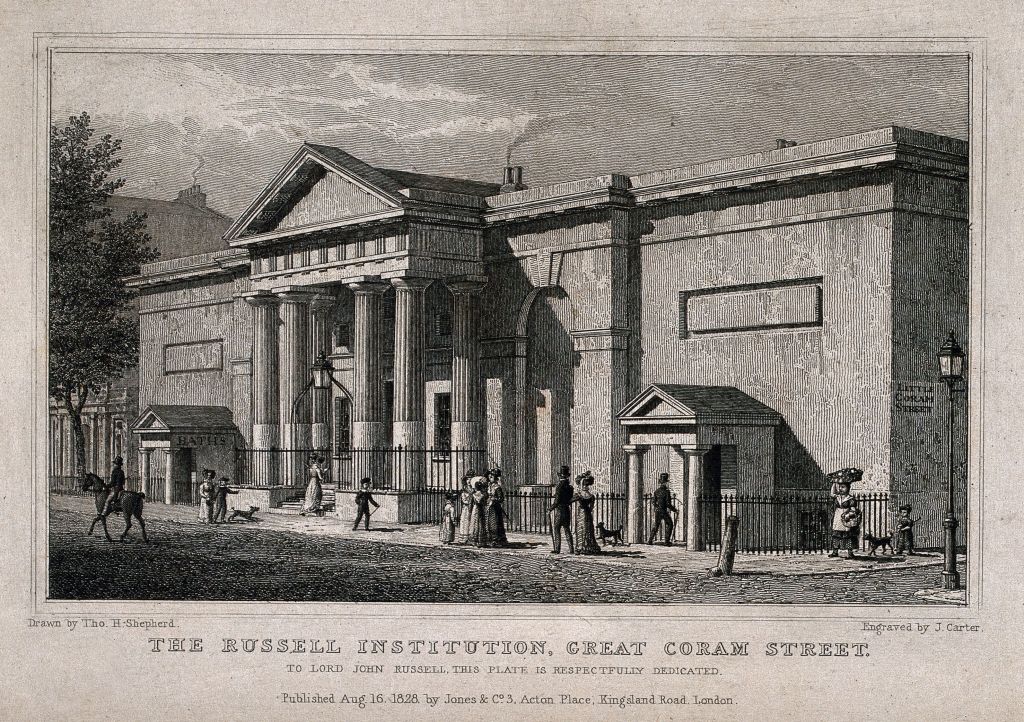 Thomas Shepherd’s 1828 engraving
of The Russel Institution, Great Corham Street. By kind permission of
the Wellcome Collection. 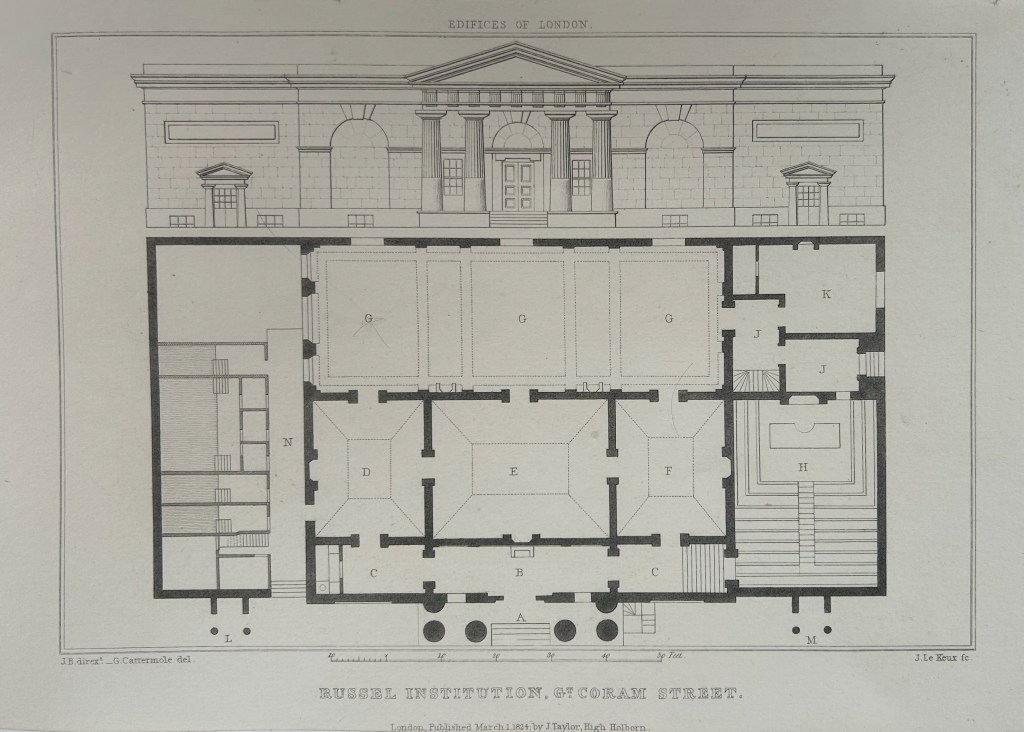 The ground floor plan of the Russell
Institution building. An engraving sadly cut from from “Illustrations
of the Public Buildings of London: With Historical and Descriptive
Accounts,� John Britton, Augustus Pugin, London, 1825. OLBC
Collection 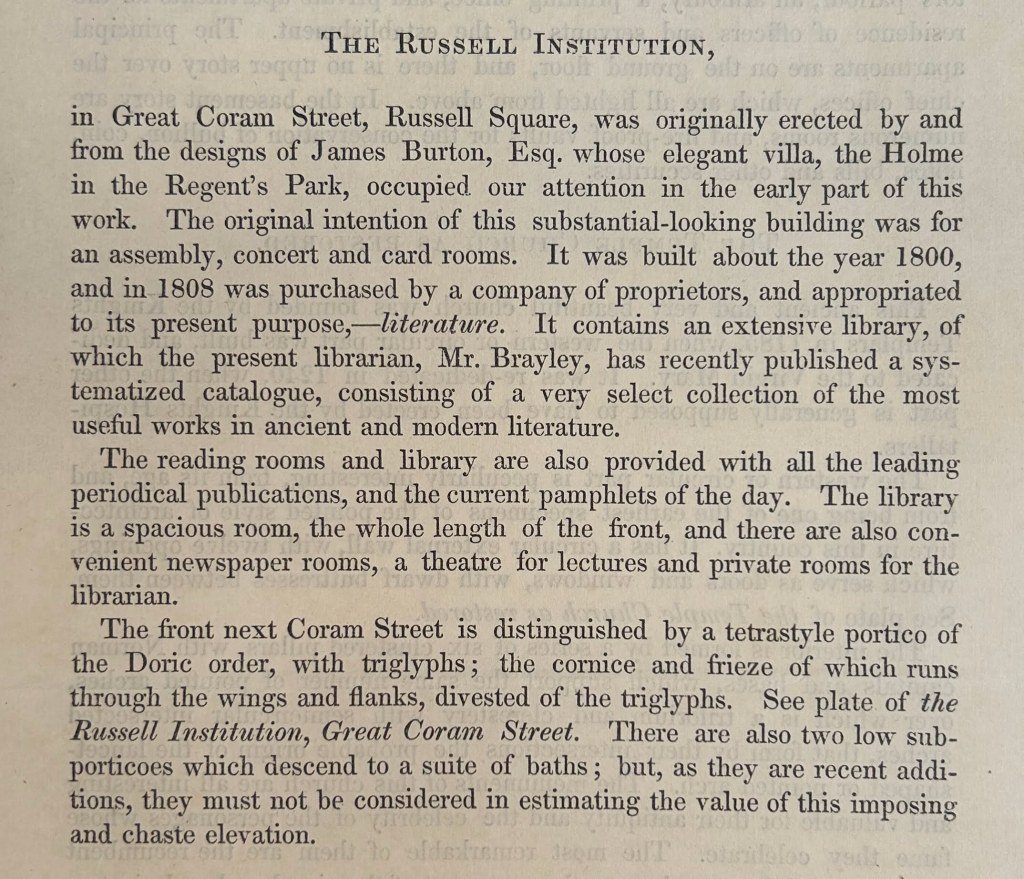 Text concerning the
Russell Institution building. An engraving sadly cut from from
“Illustrations of the Public Buildings of London: With Historical and
Descriptive Accounts,� John Britton, Augustus Pugin, London, 1825.
OLBC Collection.
The founding of the
Russell Institution
It was first proposed that the Russel
Institution be formed at a meeting held on 8th January 1808 modelled
on the Royal Institution and the London
Institution to make use of a building that had been erected by the
developer, architect and builder James
Burton. Burton had a 99 year lease on the site and erected a
building called the Russell Rooms for entertainments – this was not a
financial success and so Burton looked for another use for his building.
In An
Account of the Proceedings, with a Prospectus of the Russell
Institution, S. Gosnell, London [seemingly published around 1808, no
publication date is stated] a detailed account of the formation of the
Russell Institution is given including the compensation to Burton of two
hundred shares for the building [page 6] and implicitly the lease for it
from the Duke of Bedford. One of the founders of the Russell Institution
was Sir Samuel
Romilly who was a good friend of Jeremy
Bentham. Romilly was a well know judge and lawyer. He wrote a three
volume memoir: however, the Russell Institution does not rate a
mention in volume 2 which covers the period of interest. From the advert
in The British Press 21st May 1808, below, it is likely that the
Institution’s bankers were Marsh & Co – Berners St or Langston &
Co – Lombard Rd or Praed & Co of Fleet St. We have checked the Praed
& Co, Alphabet [customer lists] but there is no listing for The
Russell Institution. However, the account could well have been in a
person or persons names, rather than the insitution, at that point in
time.  Advert in The British Press,
21st May 1808 which names the likely bankers for the Russell
Institution.
A new roof?
According to Holland
& Hannen And Cubitts Ltd, The Inception and Development of a Great
Building Firm, Cubitts, 1928 putting a new roof on the Russell
Institution was the first major piece of work that Thomas Cubitt
undertook. 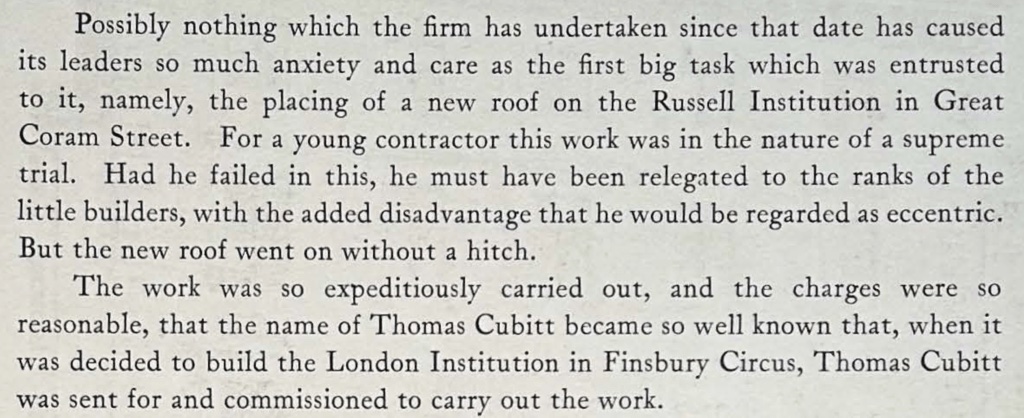
Extract from Holland & Hannen And Cubitts Ltd, The Inception and
Development of a Great Building Firm, Cubitts, 1928 Page 19. OLBC
Collection. According to *The
Sphere, *Saturday 13th December 1958 [which gives no
source for the assertion] “….in 1815 he signed his first contract to
carry out the re-roofing of the Russell Institution in Great Coram
Street …..” Thomas Cubitt’s obituary in The
Gentleman’s Magazine 1856 goes into some more detail, citing The
Builder, as its source. The obit also makes the connection between John
Shaw [doesn’t disambiguate Snr or Jnr probably Snr from the dates] and
The Russell Institution. Curiously it then goes onto state the Cubitt
was accepted for the London
Institution works on the basis of Shaw’s recommendation; whereas it
was as the result of an advertised tender process to which Cubitt
submitted the lowest bid. 
The Gentleman’s Magazine 1856 pg. 203.
The general running of
the Institution
The librarian from 1825 to 1854 was Edward
Wedlake Brayley and complied several catalogues of Institute’s
collections. In the catalogues there is a forward that set out the
history of the formation of the Institution. The interesting thing is
that it does state that the spacious cellars are let to sub tenants. It
was suggested, by others, that the fact that these had been let in the
1870’s indicated that the Institution had fallen on hard times, whereas
it appears that this had been the case from early on. 
Extract from, A Catalogue of the Library of the Russell Institution
classed and arranged by Edward Wedlake Brayley, London, 1826. Google
Books.
In the amazingly modestly named, ‘The
Manual of Dates: A Dictionary of Reference to All the Most Important
Facts and Events in the History of the World, George Henry Townsend
[ed Frederick Martin], London 1877″, sets out the the Russell Rooms had
a complex genesis. The dates need to be treated with some circumspection
as the date of the granting of the lease doesn’t give either 98 or 99
years from the end date cited in the various law reports at the foot of
this page. That aside, construction started around 1802 and there was,
seemingly, a fire that interrupted works. With the assembly rooms
opening in 1804.¹
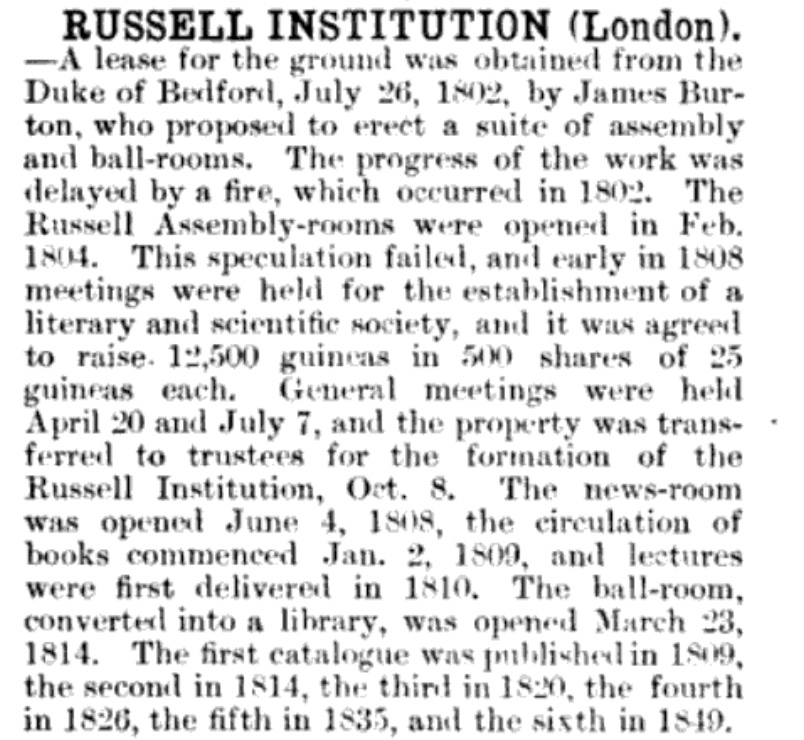
The
Manual of Dates: A Dictionary of Reference to All the Most Important
Facts and Events in the History of the World, George Henry Townsend [ed
Frederick Martin], London 1877 Pg 831. Google Books.In,
Saint Pancras, Past and Present, Frederick Miller, London, 1874 gives a
description of the Russell Institution was given that has been
frequently cited. This states that James Burton sold his interest in the
Russell Institution for £2,700 not seemingly for the 200 shares others
stated. Or it might have been that he sold his 200 shares for a
consideration of £2,700? The putative 98/99 year lease granted in 1802
[thus expiring in 1900/01] is inconsistent with lease expiry date of
29th September 1897 that is cited in The
Law Reports: Chancery Division….., Volume 2 reproduced at the foot
of the page. Hopefully the deed itself or the Bedford Estate deeds
ledger has survived. It is far more likely that the lease was granted
1798 prior to Bedford House being torn down and the demolition was a
part of James Burton’s bargain with the Bedford Estate intertwined as it
was with the bargain between the Bedford Estate and the Founding
Hospital with respect to land swaps to allow boundary alignments leading
to sensible sized plots to develop. 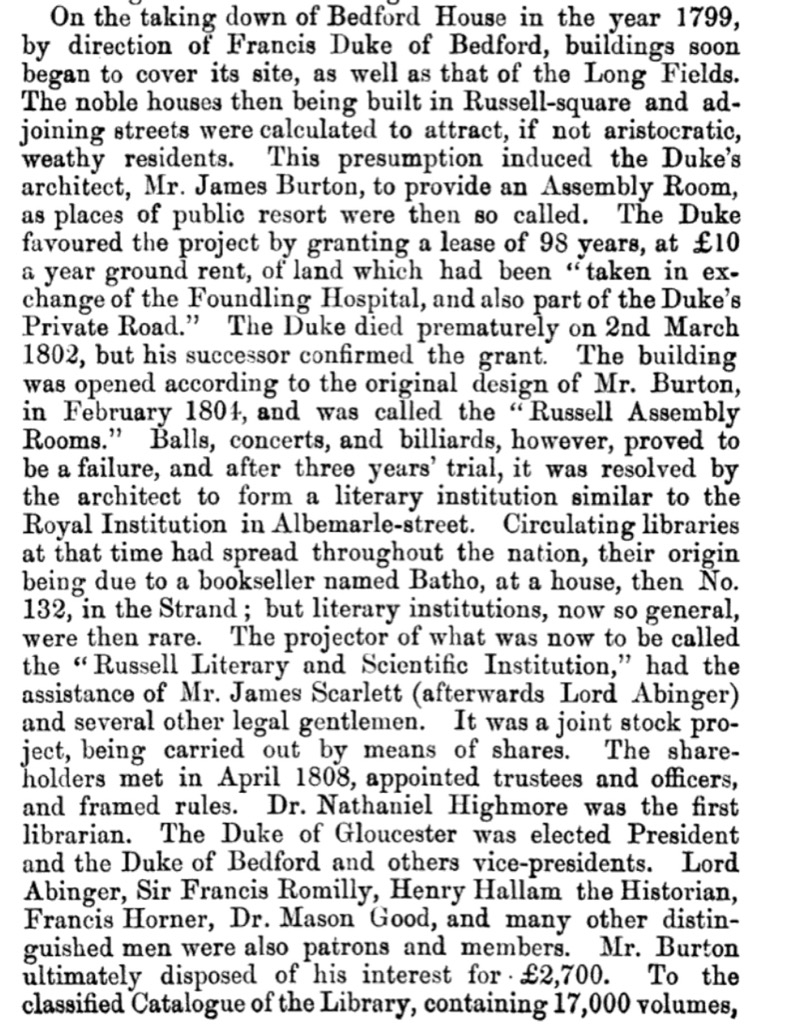
 Extract from, St Pancras Past and
Present, Frederick Miller, London, 1874 Pp 183-9. Google
Books.
The demise of the Russell
Insitution
Webber’s
Directory lists the Russell Institution in 1897. This is contrary to
most authorities who suggest that it had disappeared by 1891 as it was
not in the Post Office [Kellys] directory – this is a categorically
erroneous supposition as is made clear below. However, we can be quite
certain of the final date of the dissolution of the Russel Institution
as it as the subject of a test case, under the Literary
and Scientific Institutions Act 1854 Section 30, to determine the
distribution of assets when such and institution was dissolved. There is
a report of the proceedings in The
Times Law Reports. 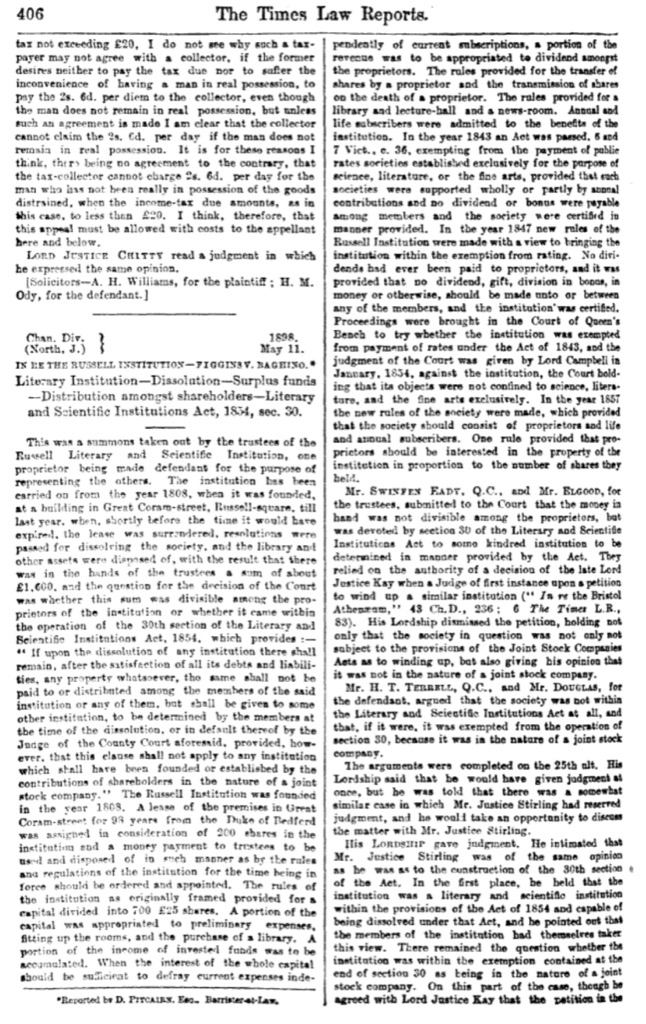
 Times Law Reports, Volume 14
edited by William Frederick Barry. Pages 406 & 7 concerning the
dissolution of the Russell Institution. There is also a fuller
report in The
Law Reports: Chancery Division….., Volume 2, which makes it clear
that the demise of the Russell Insuttion was to do with the ending of
the 98 year lease granted to James Burton and [presumably] reassigned to
the Russell Institution. Which states 
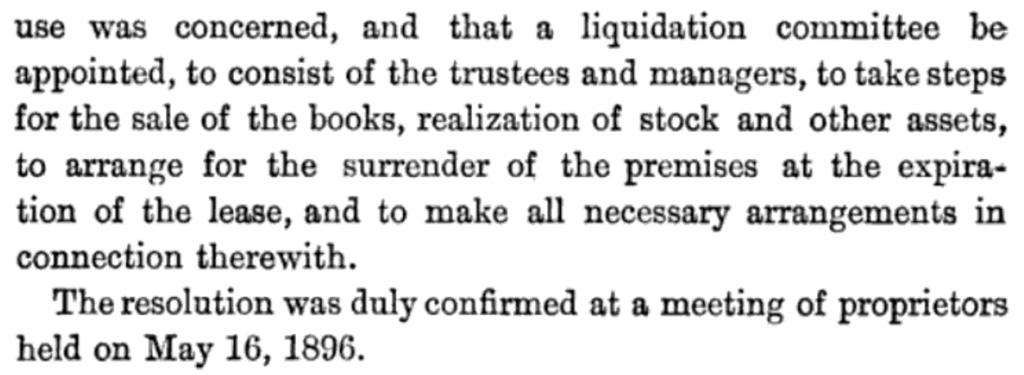
The
Law Reports: Chancery Division….., Volume 2, 1898, Pages
72-82. Both of these reports state, perhaps erroneously, that
the 200 shares had been given to the Duke of Bedford in respect of the
lease. Hopefully the lease documents will come to light and settle the
matter.
We had hoped that the fate of the Russell Institution’s library might
give a clue to where its records ended up. Of the five volumes that we
have found on the second hand market with the Russell Institution stamp
on them none of them have any other institutional markings at all. This
suggests that the collection was sold off piecemeal or given to the
shareholders in lieu of payment. So this has proved, so far, a research
dead end. The Russell Rooms / Russell Institution occupied 55 Great
Coram Street [now Herbrand Street] at the junction with Little Coram
Street. This site is now occupied by Witley Court, a block of flats.
¹ We are trying to track down any records of the lease that may
be extant in the Duke of Bedford’s archives – although it is quite
puzzling that it is stated as being the Duke of Bedford’s lands as Coram
Street was clearly on the lands of The Foundling Hospital – which
should be pretty clear from the name as Thomas Coram was it’s founder –
the answer may well be in The Foundling Hospital’s archives held at
London Metropolitan Archives likely A/FH/A/16/017/001 which is the
agreement between James Burton and The Foundling Hospital or
A/FH/A/16/015/002 which is the index for the actual leases granted. It
could well be that. There is another explanation, that has previously
been speculated upon by other authorities, in that The Foundling
Hospital could not sell lands and only exchange them so it is possible
that this parcel of lands was exchanged with The Duke of
Bedford.