

The Heaver Estate
Balham
A regency style mansion, called Bedford Hill House, was sited roughly
where nos. 12-18 Veronica Road now stand. Access was from Bedford Hill
along a lane that lay just south of the current line of Ritherdon Road.
On the far side of the Falcon Brook was a farm facing the Common. By the
1880’s this was known as Elms Farm, from which Alfred Heaver took the
name of his Elms Estate scheme and also Elmbourne Road. Some development
took place in the 1820’s, by Richardson Borradaile, which included
‘Hamilton House’, and ‘Swan House’ on Balham High Road service from
this early development. Bedford Hill House and the estate of some forty
acres of park and pasture land, was then owned by William
Cubitt, brother of the very well known developer/builder, Thomas
Cubitt. Soon after acquiring the estate, Cubitt enlarged the house
and landscaped the grounds, using the Falcon Brook to feed a large fish
pond with an island in the middle occupying what are now the rear
gardens of houses at the south end of Manville and Huron Roads. The
opening of Balham Station on the 1st December 1856 brought pressure to
release land for speculative house building, gathering momentum as the
demand for housing increased. In January 1865 the Metropolitan Board of
Works approved expenditure of £30,000 to cover over, deepen and
redirect the length of Falcon Brook from Balham to the River Thames. The
Falcon Brook had, by then turned into more of a drainage channel and the
pleasant brook that had watered the Bedford Hill House orchards and
filled the fish ponds was now a distant memory. For a time, Bedford Hill
House lay empty, a remnant of early Balham, with the houses of the
Heaver Estate gradually encroaching upon its lawns and gardens. By 1897,
with the building of Veronica Road, it too, was finally demolished.
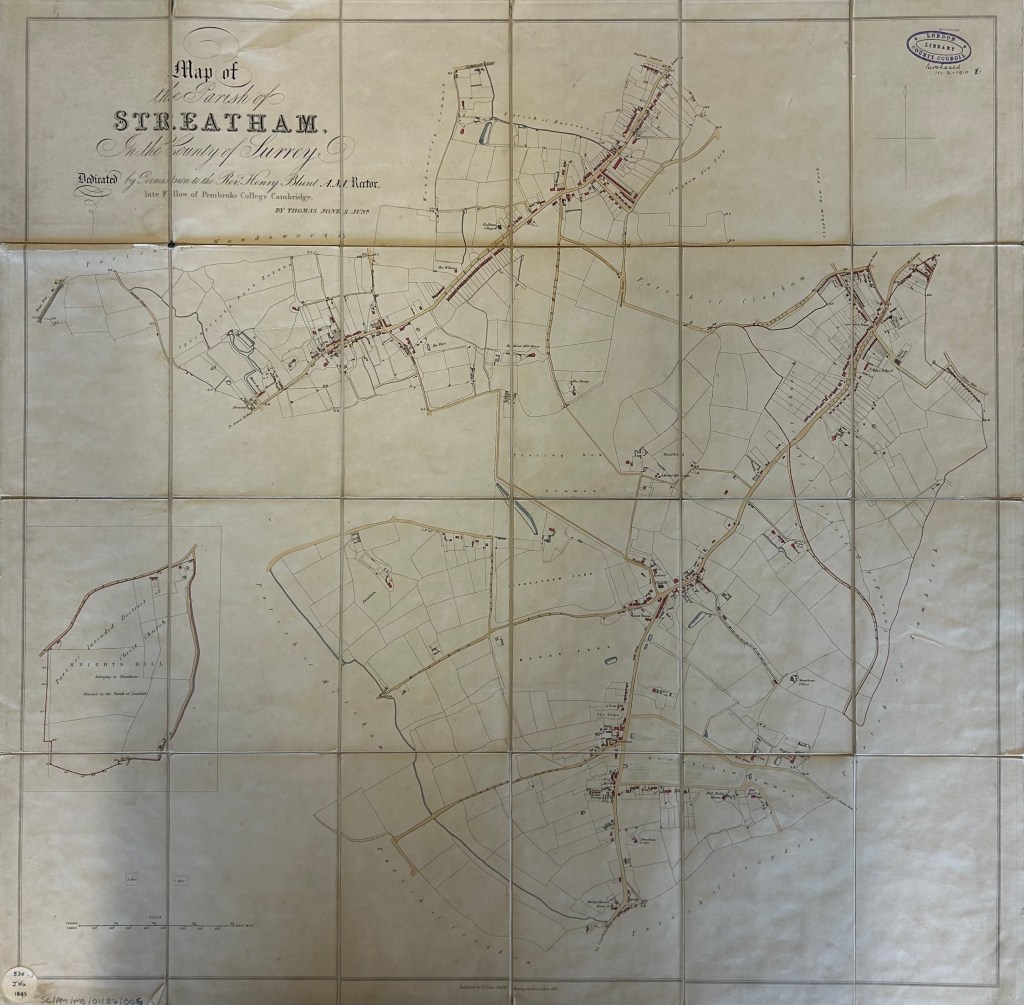 Map of Streatham ca 1843 by Thomas Jones
Junior. London Metropolitan Archives SC/PM/MB/01/27/005 The
Ordnance Survey 1868-1881 Surrey County Maps still shows essentially
empty fields other than development along Balham High Road. By the time
of the Ordnance Survey 1896 London Series Maps development is well
underway with both Huron and Streathbourne Roads half built out from
Balham High Road, Elmbourne Road Completed and Drakefield and Louisville
Roads starting their build out from Balham Hight road as well. 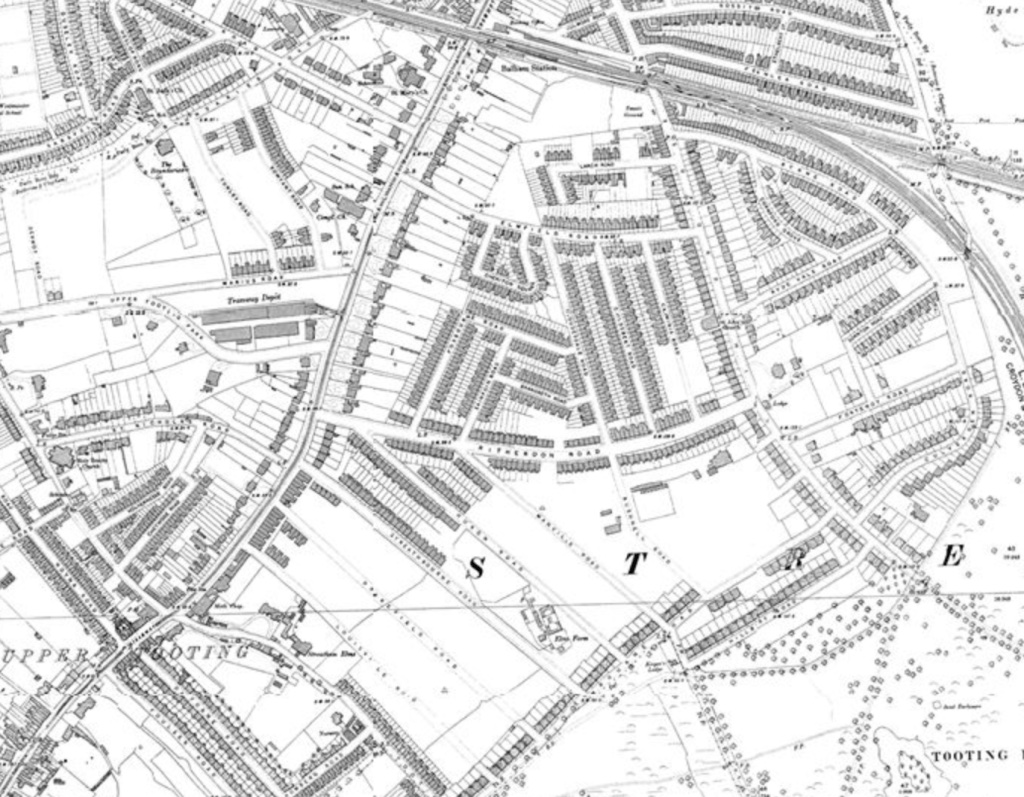 Historic
Ordnance Survey 1896 London Series Map showing the progressive
development of the Heaver Estate.
Tithe Maps and Tithe
Books
The Tithe Map and Tithe apportionments make the extent of Alfred
Heaver’s development operations very clear. Incidentally he also
developed a patch of land either side of Wandsworth Bridge Road.
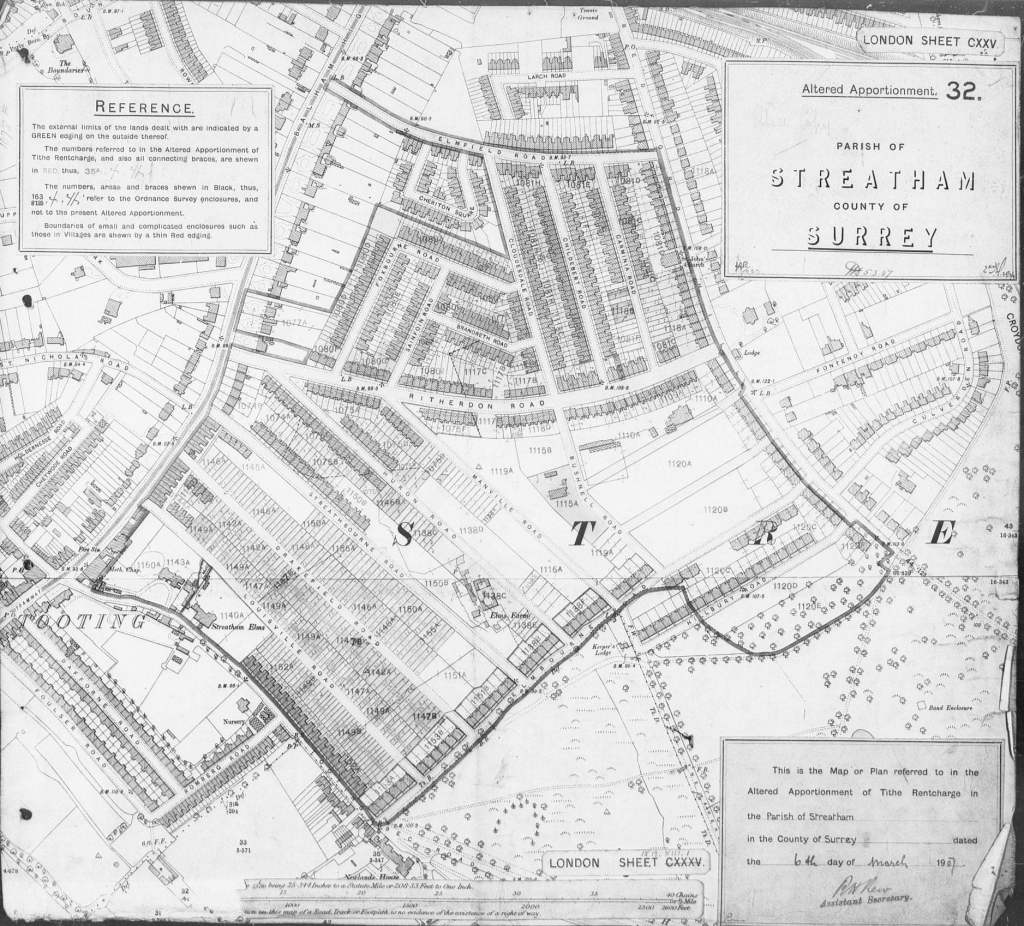 March 1907 Tithe
Map of the Heaver Estate in Balham still showing it partially developed
– National Archives IR30 series 34/114A/348 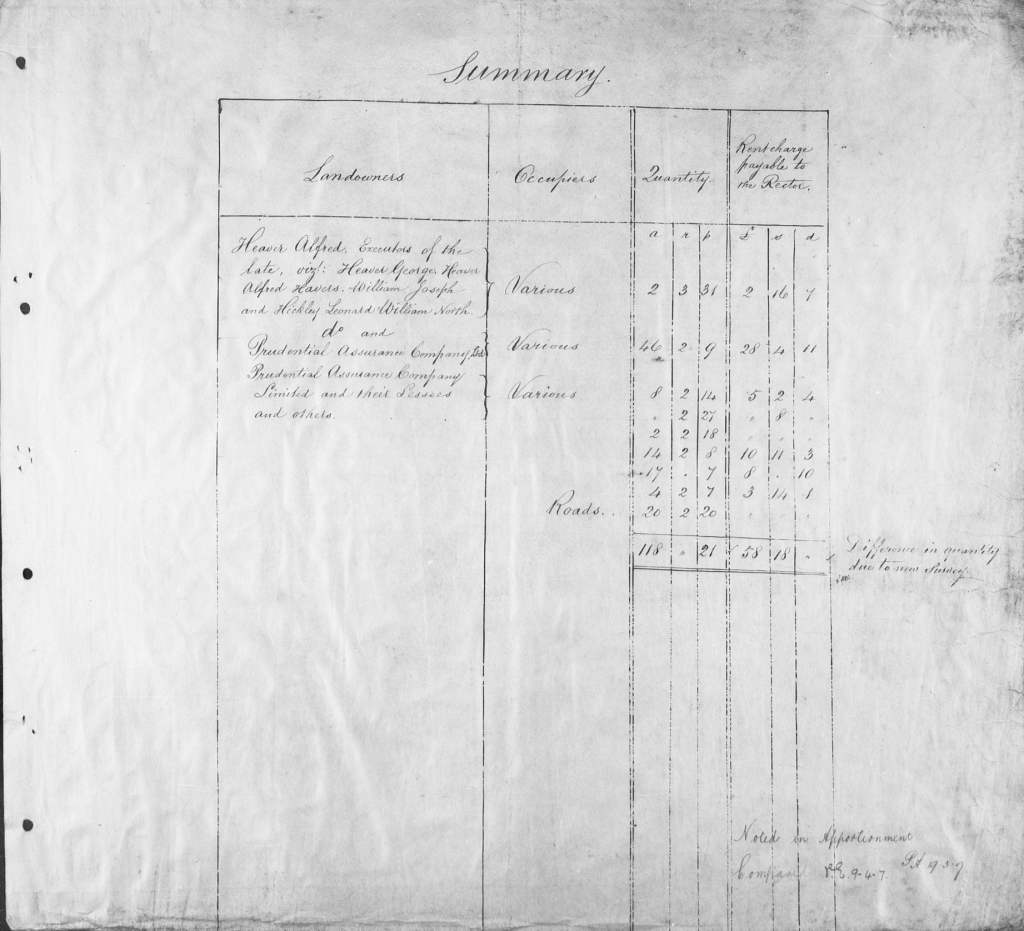
Tithe Book Records for The Heaver estate Balham – showing it was Alfred
Heaver’s executors who paid off the Tithe – National Archives IR30
series 34/114A/351 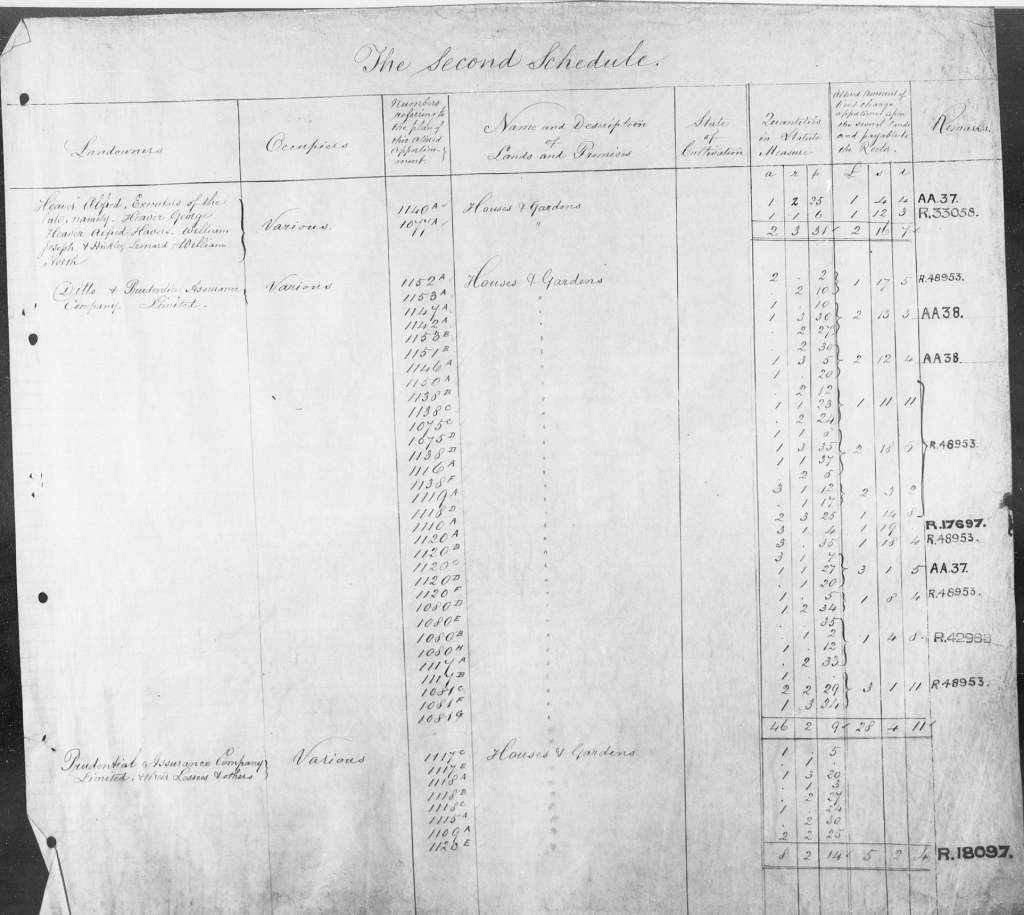 Tithe book
entries for The Heaver Estate Balham. Showing the extent of
mortgaging/ownership by The Prudential Insurance Company Ltd. – National
Archives IR30 series 34/114A/349
Alfred
Heaver – the man who created The Heaver Estate
Alfred Heaver (10 February 1841 – 8 August 1901) was an English
carpenter turned builder and property developer, responsible for the
construction of a number of housing estates amounting to thousands of
homes in south London, including the Heaver Estate in Balham.
He was murdered in 1901 by a relative who nursed a grudge against him.
This is where things get a bit murky and some effort needs to be made to
separate facts, from primary sources, from good sounding stories that
have been recirculated over the decades. The Survey of London dubs him “the big-scale
yet shadowy South London developer-builder”. [Chapter 10: The Shops of
Clapham Junction”. Survey
of London 49: Battersea (draft) (PDF). English Heritage / Yale
University Press. 2013]. Whilst it is true that Heaver did go bankrupt
after an early building venture [“The
Bankruptcy Act 1869” (PDF). The London Gazette. 14 March
1871. p. 1407] this trope is demonstrably far from the truth: the 1907
Tithe records, above, show the majority of the properties has been
promptly remortgaged to The Prudential Assurance Company. This is a very
sensible and logic manner of proceeding with secured cashflow. This is
also about the most impeccable source of funding that you could wish to
have. 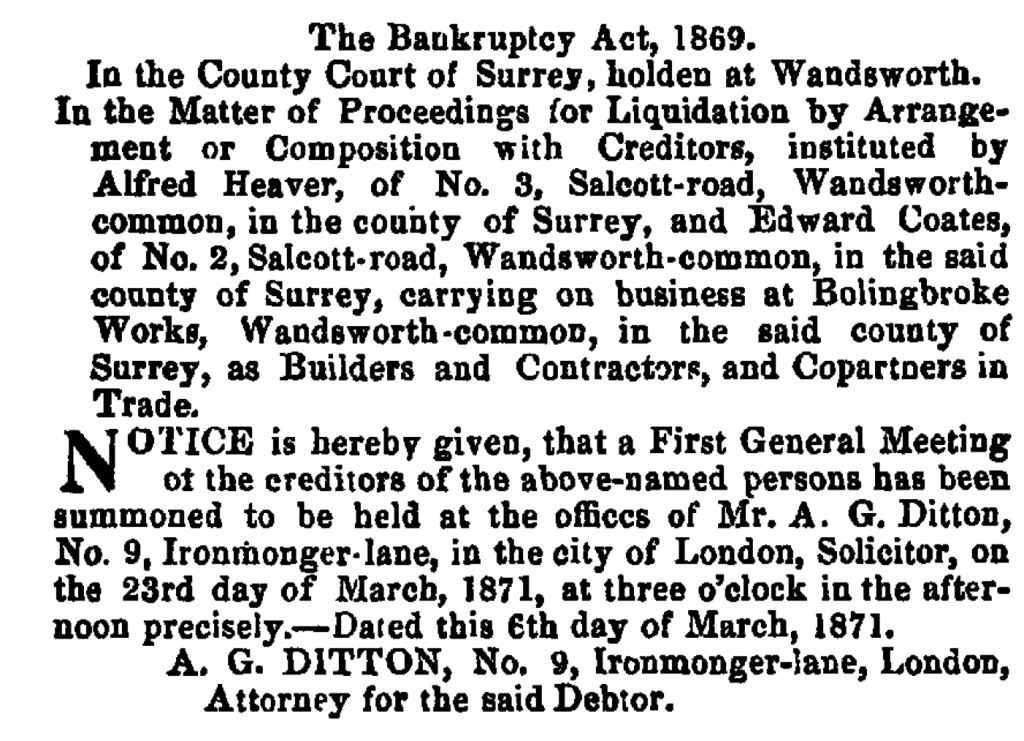
Bankruptcy notice for Alfred Heaver and Edward Coates. The London
Gazette. 14 March 1871. p. 1407. From an initial examination
of the building and deeds records it would appear that Heaver kept one
in twelve of the houses for himself and sold or remortgaged the others.
This makes a great deal of sense as a well run small to medium
enterprise would expect a net profit of 5-8%. Heaver clearly learned
from his earlier troubles and set himself up on a very clear and
straightforward path. Keith Bailey states, without any apparent
investigation, that the source of capital for his entrée into
large-scale estate development is unclear [Bailey, Keith Alan (1995). The Metamorphosis of
Battersea 1800-1914: A Building History (PDF)(PhD). The Open
University]. Keith Bailey goes on to state, without any evidence other
than a press clipping with a differing amount, that the size of Alfred
Heaver’s estate, after his murder, was uncertain [Bailey, Keith Alan
(1995). The
Metamorphosis of Battersea 1800-1914: A Building History
(PDF)(PhD). The Open University].. However the probate register entry
for Alfred Heaver is quite clear and it was not revised at all. So this
looks perfectly above board. The fact that probate was granted in the
same month as his death also points to his affairs being in good order.
Examination of the Grant
of Probate, dated 31th August 1901, reveals the source for this
misinterpretation of plainly stated facts: The Wandsworth Brough News
had simply added the value the Personal Estate [£235,260] to the value
of the Total Estate [£389,883] to produce a sum of £625,143. This
shows the very clear value in going back to primary sources – such
errors are plain to see. The level of the organisation of Alfred
Heaver’s estate can be gauged from a number of sources. The two most
substantial being his massive and detailed will
[click for full PDF] and The
Deed of Arrangement [click link for full PDF] which was made prior
to his death split the huge amount of housing stock which he owned
between his sons.  Extract from
Alfred Heaver’s Grant of Probate dated 31st August 1901 clearly stating
the sums.  Alfred Heaver’s
Probate Register Entry 31st August 1901 valuing his estate at £389,883
19s 9d. A close reading of Alfred Heaver’s 25
page will of 1898 also gives the impression of a very businesslike,
clear and organised mind. The one thing that does leap out from the page
of the will is that his early partner Coates isn’t treated as being
close to him but merely as an employee [pg. 4]. Given that his children
are provided with sevenths of the estate, this two sons get two sevenths
each of the nearly £400,000 or each seventh being worth £57,000 in
1901 money. 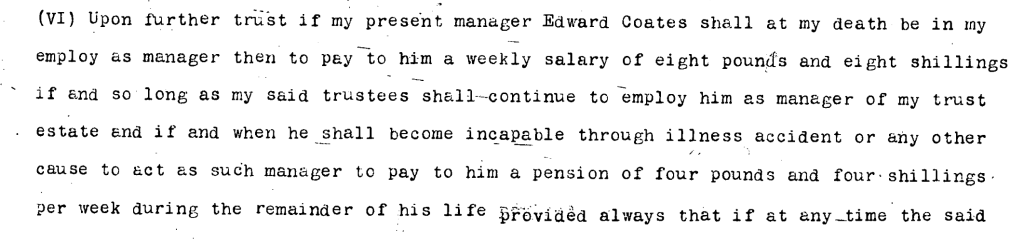
Passage re. Edward Coates, from Alfred Heaver’s will of 28th March 1898
pg. 4. Upon further trust if my present manager Edward
Coates shall at my death be in my employ as manager then to pay to him a
weekly salary of eight pounds and eight shillings if and so long as my
said trustees shall continue to employ him as manager of my trust estate
and it and when he shall become incapable through illness accident or
any other cause to act as such manager to pay to him a pension of four
pounds and four· shillings. per week during the remainder of his
life…… Edward Coates shall though capable refuse to or to
continue as manager aforesaid or if my said Trustees in the exercise of
their discretion (which shall be absolute regard to this matter) either,
shall decline to employ him, or shall dismiss him from his employment as
such manager (either on the grounds of his employment being unnecessary
or on any other ground) then my said Trustees shall pay to him a sum:of
five hundred pounds free of duty and thereupon the said weekly payment
of eight pounds and eight shillings shall cease and the pro vision for
payment of the said pension shall become inoperative but none of the
said weekly-payments-made prior to such refusal or dismissal of the
aforesaid shall be taken or considered to be in part satisfaction or
discharge of the said sum of five hundred pounds Provided that the said
Edward Coates shall not have any right to the said sum of five hundred
pounds or any other payment under this :clause unless he shall , be in
my employ as a manager at my death. Excerpt from the will of Alfred
Heaver – 2nd March 1898 – setting out the remarkably cold terms for the
continued employment of his initial business partner. This gives a
valuable insight into Heaver’s unsentimental thought processes. Edward
Coates is to be supported by his Trustees but in an estate where the
portions to the descendants were £57,000 to leave £500 is far from
overtly generous.
Alfred Heaver’s
Developing Housing Business
It is clear from a search of the Minutes of Proceeding of the
Metropolitan Board of Works that Alfred Heaver became very active from
1879. We
have searched the minutes and collated the search results here on a
separate page. We can also see from the maps and the extant building
records that construction proceeded at quite a steady pace. There was no
sense of streets being thrown up speculatively. Heaver, had learned from
his earlier bankruptcy and developed a sound business model – build
steadily with a substantial cash buyer to hand, sell the majority on
completion to attain good cashflow and retain the profit element as
houses. 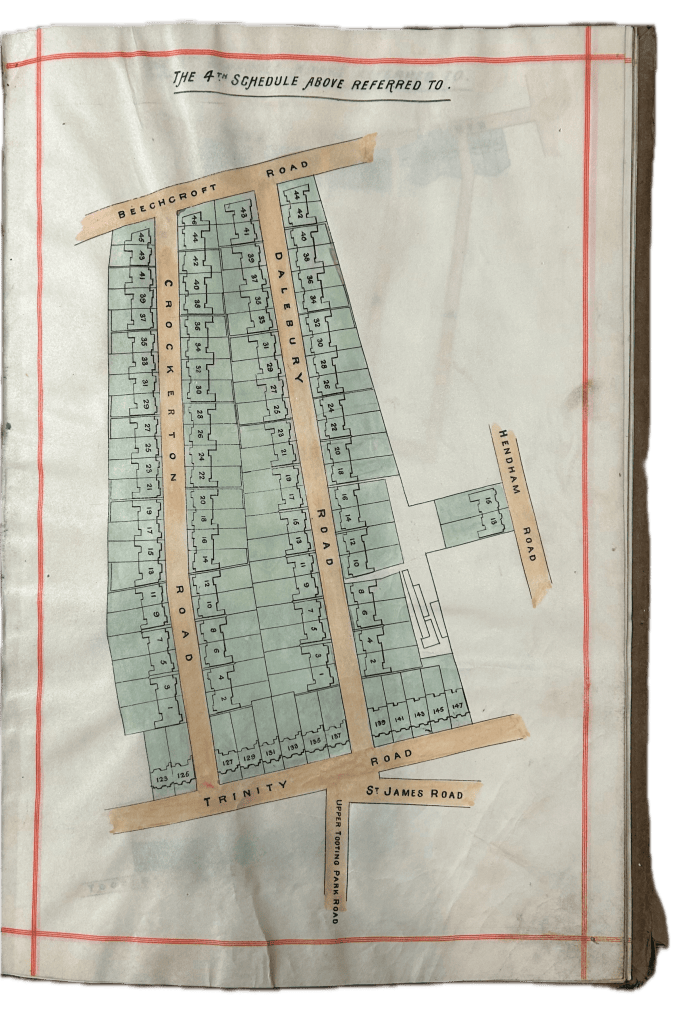
A plan page from the Deed of Agreement dated 20th March, 1893 showing
the housed on Trinity, Hendham, Dalebury, Crockerton and Beechcroft Hill
Roads that had been retained by Alfred Heaver to be divided between his
sons George Heaver and Alfred Heaver [the younger]. By kind permission
of Wandsworth Heritage Services. Deeds.As can be seen for the
Tithe book entries and The
Deed of Arrangement [click link for full PDF]: Heaver kept a few of
the houses for himself, no doubt as assets and as a source of income.
The clear conclusion that can be made from all of this is that Heaver
became a very adept businessman before his untimely death.
Heaver and The Pru
Contrary to a lot of stories, Alfred Heaver, obtained most of his
later finance from The Prudential Assurance Company Limited [The Pru].
There is absolutely no mystery about this at all as it is stated in both
the tithe books as well as a number of extant deeds. You can read the 1st
October 1897 Eight Deed between Alfred Heaver & The Prudential
Assurance Company Limited [click link for full PDF]. 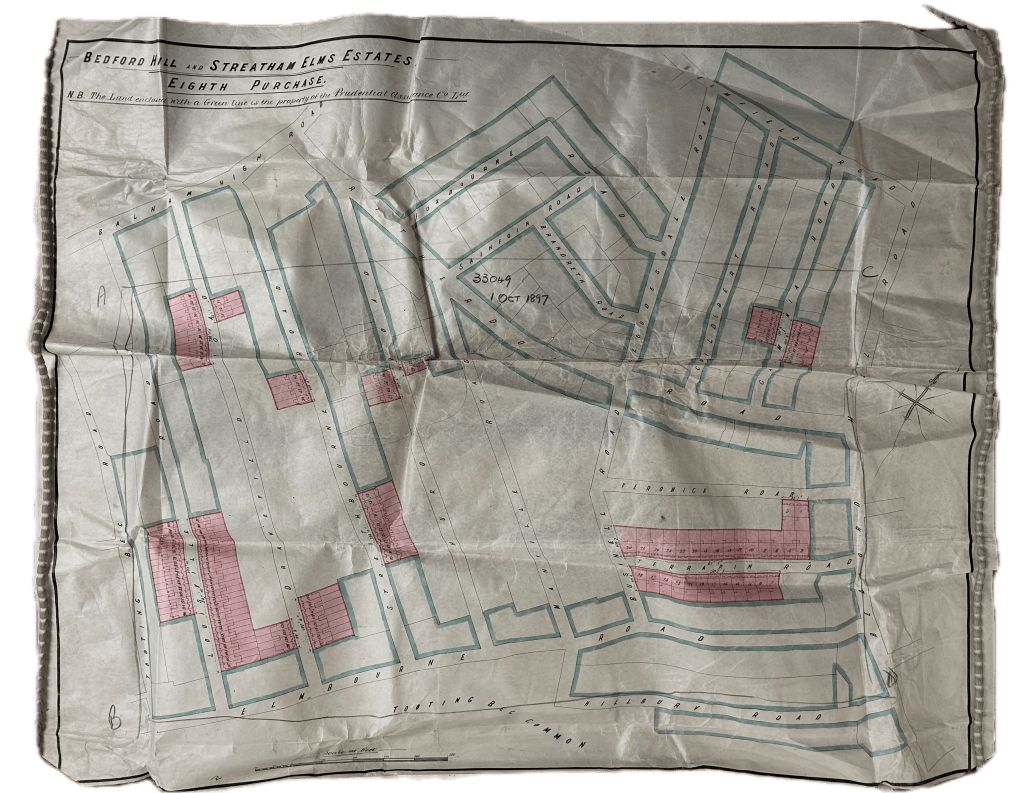
The rather crumpled plan page from the 1st October, 1897 deed between
Alfred Heaver & The Prudential Assurance company Limited. By kind
permission of Wandsworth Heritage Services. Deeds
Deed of Family Arrangement
An extensive bound and printed deed of family arrangement was drawn
up dividing the very substantial remaining property holdings between
George Heaver and Alfred Heaver [the younger] dated 20th March, 1893.
Even producing such a deed would have been a substantial investment.
However, given the size and scale of Alfred Heaver’s holdings it made
perfect sense to print the pages listing out the properties, otherwise a
longhand version would have been massive and hard to consult or copy.
The deed lists out holdings in Fulham, Wandsworth & Clapham. We are
fortunate that a full copy survives as it sheds a very clear light on
Alfred Heaver’s business style and execution. The
Deed of Arrangement [click link for full PDF] is a substantial
document which contains a full schedule of properties as well as
coloured plans. It is very clear from the 5th Schedule Plan [below] that
the best and largest houses, on The Heaver Estate, Balham, had been
retained as family assets. Presumably, as these would give the best
yields. 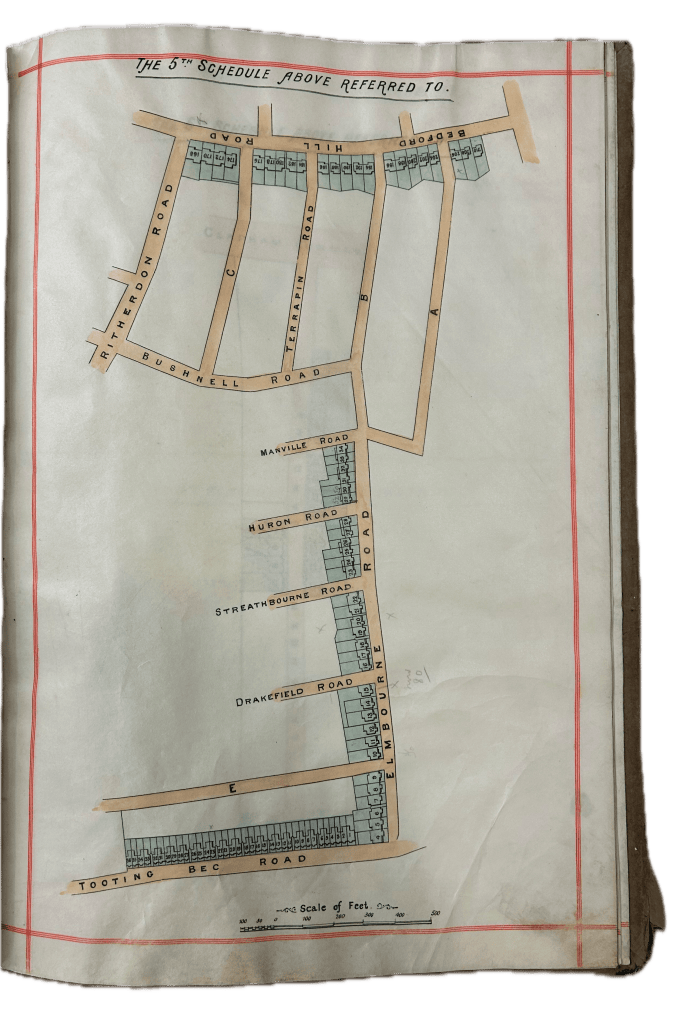
A plan page from the Deed of Agreement dated 20th March, 1893 showing
the housed on Elbourne Road and Bedford Hill Road that had been retained
by Alfred Heaver to be divided between his sons George Heaver and Alfred
Heaver [the younger]. By kind permission of Wandsworth Heritage
Services. Deeds. A sample page [below] from Deed of Agreement
dated 20th March, 1893 listing out the houses that had been retained by
Alfred Heaver and how they were to be divided between his sons George
Heaver and Alfred Heaver Junior. 
Page from the schedule of the Deed of Agreement, dated 20th March, 1893
. By kind permission of Wandsworth Heritage Services. Deeds
Why do some of the houses on the Heaver Estate have historical
basements? One of the things that is really obvious from this
1937 oblique aerial photograph is the varying topography of the lands.
This leads in the middle section of most of the roads such as Huron,
Drakefield and Louisville to the formation of historical basements with
front access steps. Usually in Edwardian or Victorian building practice
the addition of a basement is a pure reflection of the historical ground
levels. The road levels were dictated by the mains drainage which was
gravity drained so no dips were allowed. Given that carting fill
materials around, such as soil, ballast or sand was very hard and
expensive with a horse and cart a different solution was often arrived
at: a basement. These historical basement excavations, with the spoil
used to make up the road levels, should not be confused with the coal
cellars that were essential at the time for housing developments at this
level. This makes the Heaver Estate a very natural place for basement
conversions and basement
excavations. Aerial Photography Pre war photo of the Heaver Estate:
a 1937
oblique shot looking from Tooting Common towards Balham Station.
Post war, 1947
RAF image, showing the areas of bombed out houses