

This series of blogs in our From The Archives series is
intended as a resource for schools and local residents who are
interested in researching local history. School children should feel
free to use the images in these blogs for their projects or homework. We
are very happy to help schools with access to relevant materials.
However, the images that are reproduced here should be assumed to be the
copyright and may not be reproduced without license from the archives
and commercial use is therefore strictly prohibited.
The
West Hill Estate Developing Into Mass Housing – Haldon Road &
Surrounding Roads – Part V – John Augustus Beaumont
John Augustus Beaumont retired from The County Fire Office in 1877
through ill health, at which point some of the energy of the Wimbledon
Park and West Hill Estates schemes clearly dissipates.
Far more of the activity them moves to selling chunks of land off to
third parties who then develop them, often at significantly higher
densities, than Beaumont envisaged in his original grand scheme.
Here, we are going to take a look at the way the proposed development
in the area around Haldon Road from the grand Beaumont plan to that of
the large and small scale developers or relatively high density terraced
housing.
Road building
It seems clear that Haldon Road, formed in a great sweep, was to have
been another of Beaumont’s grand roads and was shown as such on
the 1879
Wimbledon Park Estate plans.
Looking at the pile of documents and plans, this turns into quite a
confusing story, with a lot of different versions of plans and drawings
with different dates some not showing things that they should show.
Fortunately, there is a single source of truth as to the dates that
roads were authorised to be created and named. In 1855, the Metropolis
Management Acts were passed. The Acts created a Metropolitan Board of
Works to control, amongst other things, the creation and naming of new
roads and places.
Periodically summary volumes of the dates of creation of road and
places were therefore published.
This led to a series of volumes that were published by the London
County Council, which succeeded the Metropolitan Board of Works. From
the “List
of Streets and Places within the Administrative County of London� 3rd
Edition, LCC, 1929 it is clear that the following streets
were created at the following dates.
Sedleigh Road – 1869
Ringford Road – 1869
Amerland Road – 1869
Haldon Road – 1869
Southfields Road – 1884 – although this is almost certainly the
extension of Southfields Road to enable the construction of Jephtha Road
(Gardens). As was discussed previously in
a previous post Southfield Road is actually a section of
The Wimbledon to Wandsworth footpath across The South Field that was
turned, in part, into a road.¹
Jephtha Road -1884 – this date is shown is brackets and it is not
clear why this is – this could well be to do with how confused the
records are. Although we do actually have the approved signed plan dated
7th March 1884 – below, so we can be absolutely sure that the date
is correct.
The professionals arrive
The
United Land Company Limited appear in this narrative around
1869.
Samuel Wylson is their agent/surveyor and in a number of schemes and
his signature can been seen on many of the drawings. What is clear is
that this is a sub estate, but in quite a number of documents it is
defined as being a part of West Hill Estate, which is a puzzling
statement. Maybe West Hill Estate had gained some cachet The United Land
Company were desirous of trading on?
The scheme then developed in stages to attempt to connect Southfield
Road with West Hill Road (which was rejected) and then to ultimately
create Jephtha Gardens (later Jepththa Road) via a bizarre hotel scheme
in a highly unlikely place.
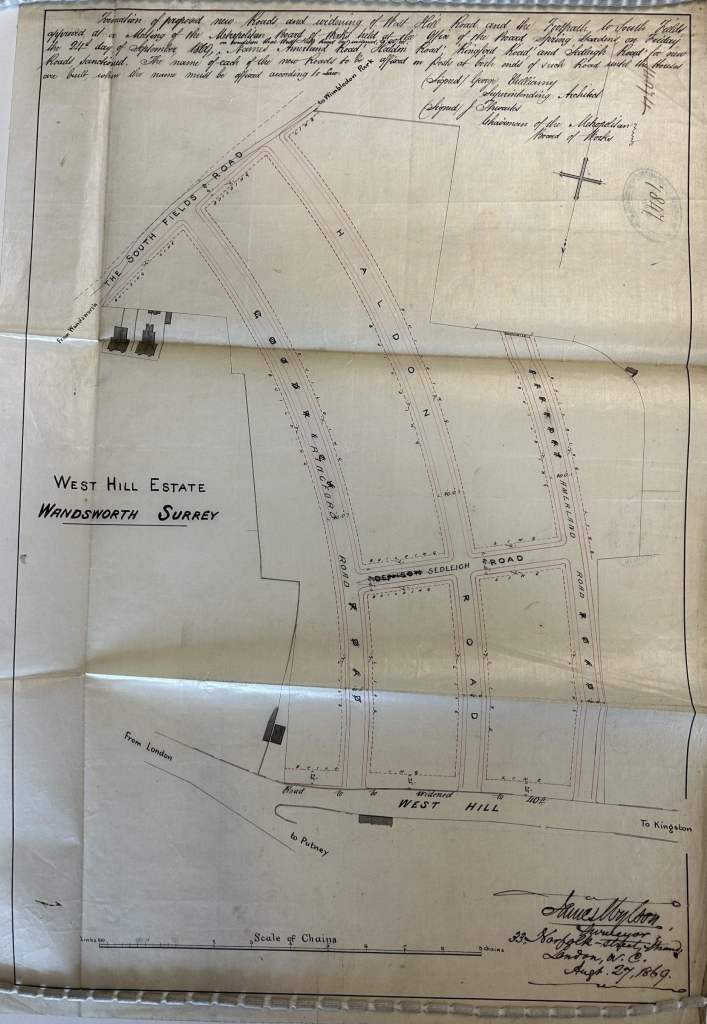
The application for the formation of the roads off of Haldon Road –
dated 27th August 1869 – London
Metropolitan Archive – MBW/BA/31578 and 14074
A small scale developer
tries his luck
Haldon Road appears hand marked onto an Ordinance Survey Large Scale
sheet dated 1871 which is used as the basis for the application for
Jephtha Gardens. There is another sheet shown further down this blog
post which shows the application for the other side roads which was made
at the same time.
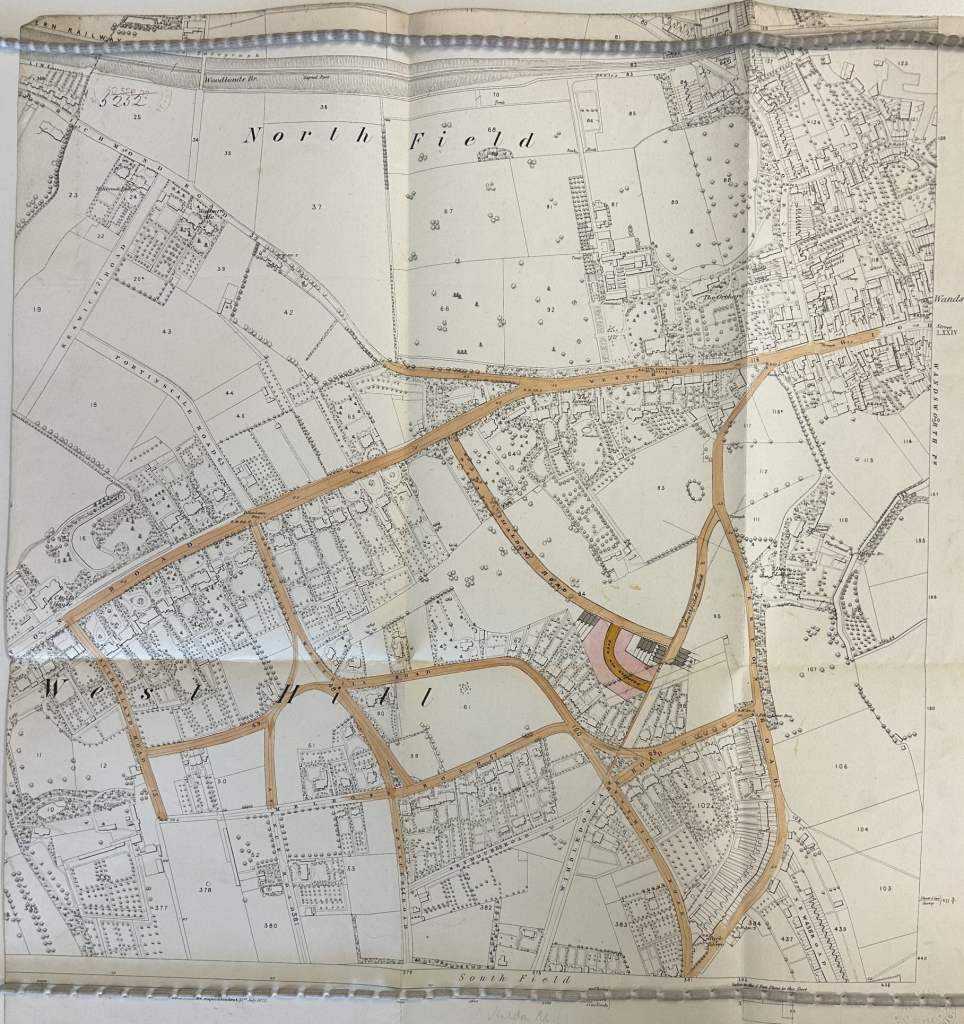
Elsdon’s 1884 application for Jephtha Gardens – on an Ordinance Survey
sheet dated 1871 – London
Metropolitan Archive – MBW/BA/31578 – if you look at the plan
closely you can see that Haldon Road has been marked on by hand as the
trees are clearly visible underneath the road markings! It also seems an
extraordinarily lazy submission in that Amerland, Sedleigh &
Ringford Roads had also all been approved in 1869 so they really should
have been marked on the plan, even by hand. It is also clear from the
plan submitted that Elsdon, his stamp is on the bottom right hand corner
of the sheet, hadn’t quite given up on his idea of extending Southfields
Road to West Hill Road. However, there is no significant
development shown along Haldon Road. Elsdon clearly gets a bit annoyed
with being constrained by process and threatens to go ahead and build
the road anyway. 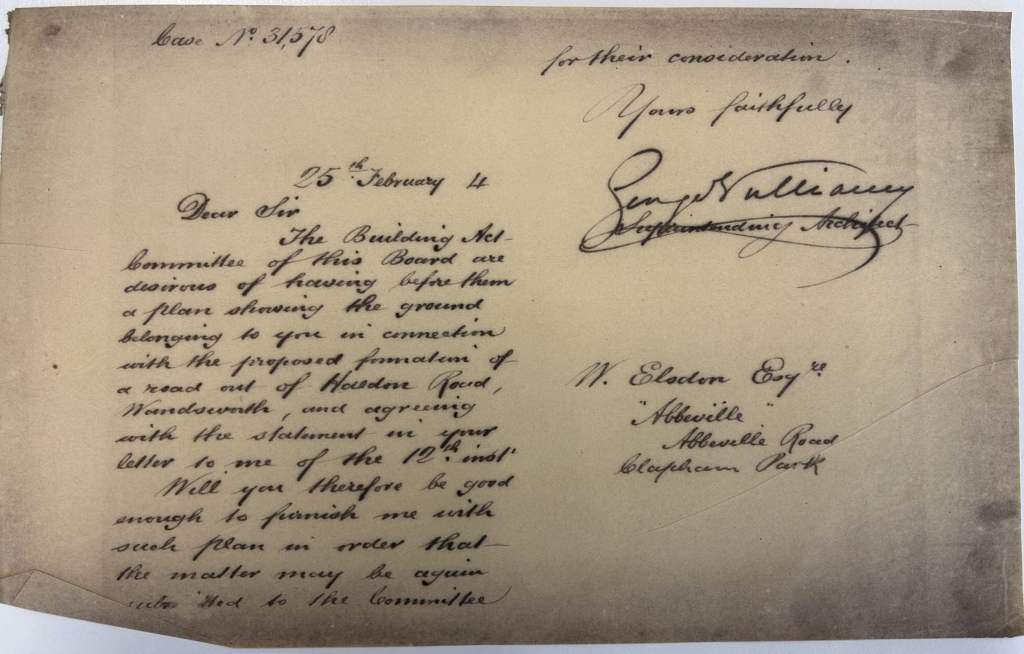 Copy
letter of 25th February 1884 requesting Elsdon to clarity if he own all
of the ground or not – he probably didn’t own the vital corner looking
at the form of the 7th
March 1884 plan further down this blog – London
Metropolitan Archive – MBW/BA/31578 The Metropolitan
Board of Works and Wandsworth Board of Works were none too impressed by
this letter. Leading to the following perfectly dry response. 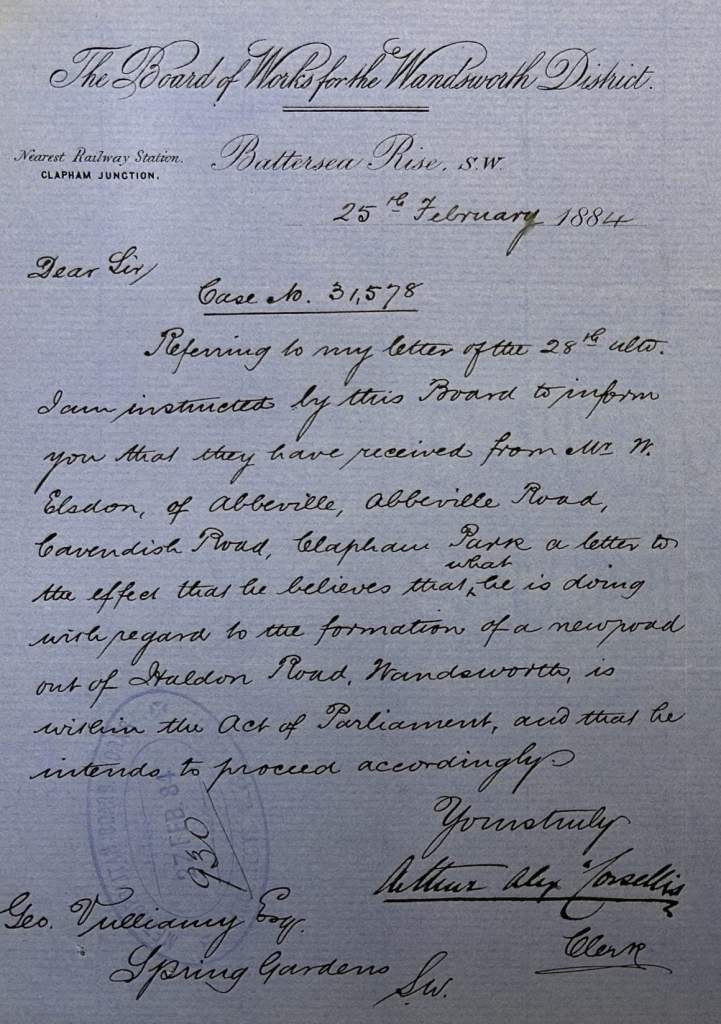
25th February 1884 Response to Elsdon’s Letter of 25th February 1884
threatening to go ahead and build Jephtha Gardens anyway even without
permission! – London
Metropolitan Archive – MBW/BA/31578
Part of this delay, which clearly irked Elsdon, could be to do with
the Putney Relief Sewer Scheme, which runs underneath Ringford Road and
ran on a very impressive aqueduct across, what is now, King
George’s Park, that Jospeh Bazalgette was designing but
was not fully implemented until 1885.
This didn’t stop another enterprising builder from trying to build
a house on the extension to Southfields Road before it was
approved, never mind created, leading the Wandsworth Board of Works to
write the following letter:
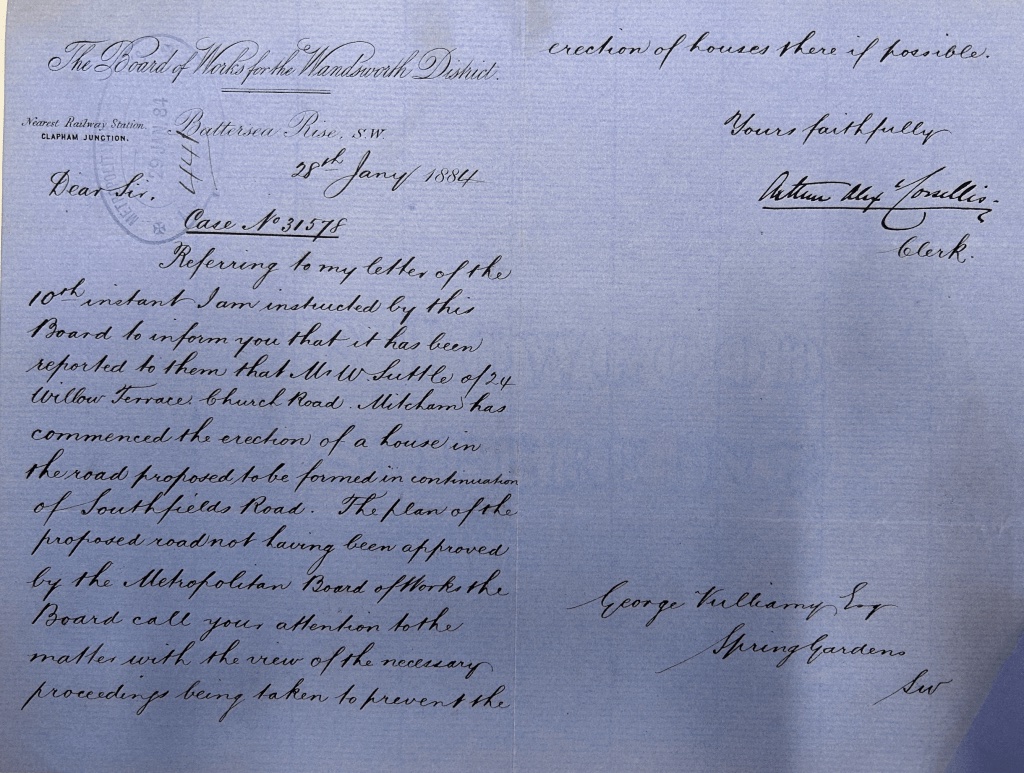 Letter from the Wandsworth Board of
Works dated 28th January 1884 concerning the erection of a house on a
section of Southfield Road that has not been approved never mind built.
London
Metropolitan Archive – MBW/BA/31578 and 14074
While The United Land Company were setting out their estate they had
agreed with the owner of the other side of Southfields Road, Captain
Bunbury, to utilise some of his land in their shared
endeavour of creating Southfields Road. However, Captain Bunbury died
sometime before 1870, and so the road was not able to be constructed to
the specified forty foot width, leading to some exchanges of letters
between The Metropolitan Board of Works, The Wandsworth Board of Works
and The United Land Company’s agents.
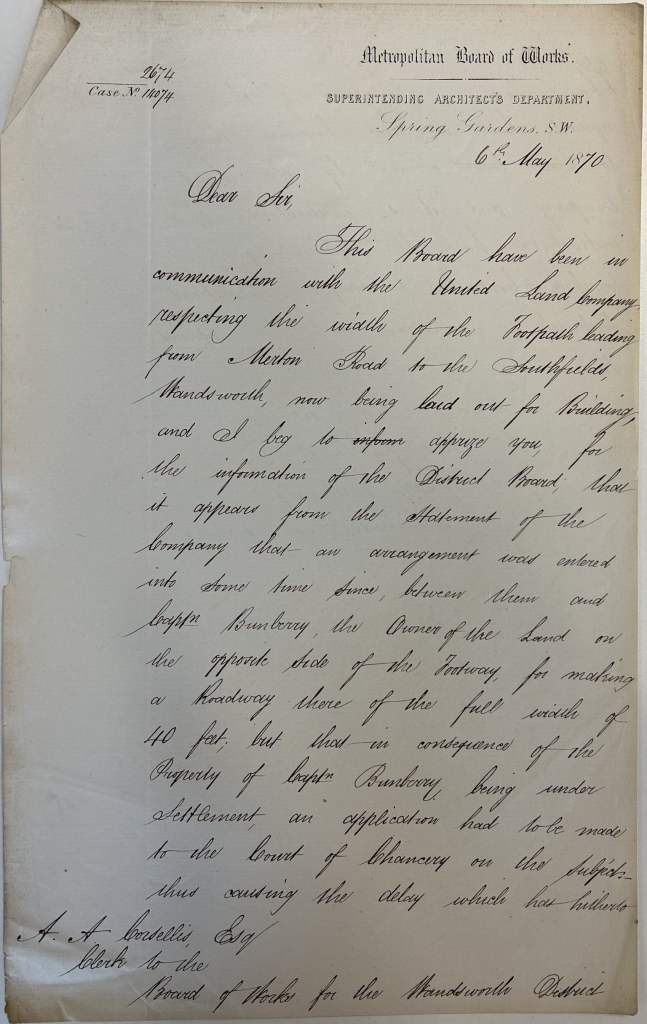 Letter
from The Metropolitan Board of Works Architect’s Department to
Wandsworth Board of Works dated 6th May 1870 regarding the width of
Southfields Road and the death of Captain Bunbury impeding its widening
– London
Metropolitan Archive – MBW/BA/31578, 2674 and 14074
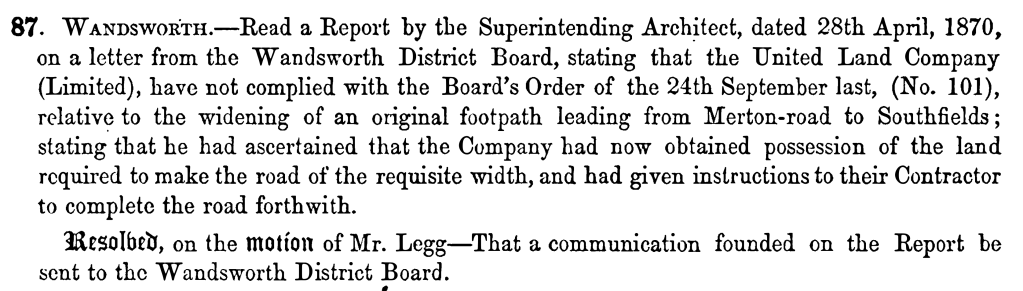
Minutes of Proceedings of the Metropolitan Board of Works – 29th April
1870 page 482 – OLBC Archives Ultimately, the United Land
Company Ltd now have their scheme, and this rather beautiful plan is
published of which a few different versions survive. 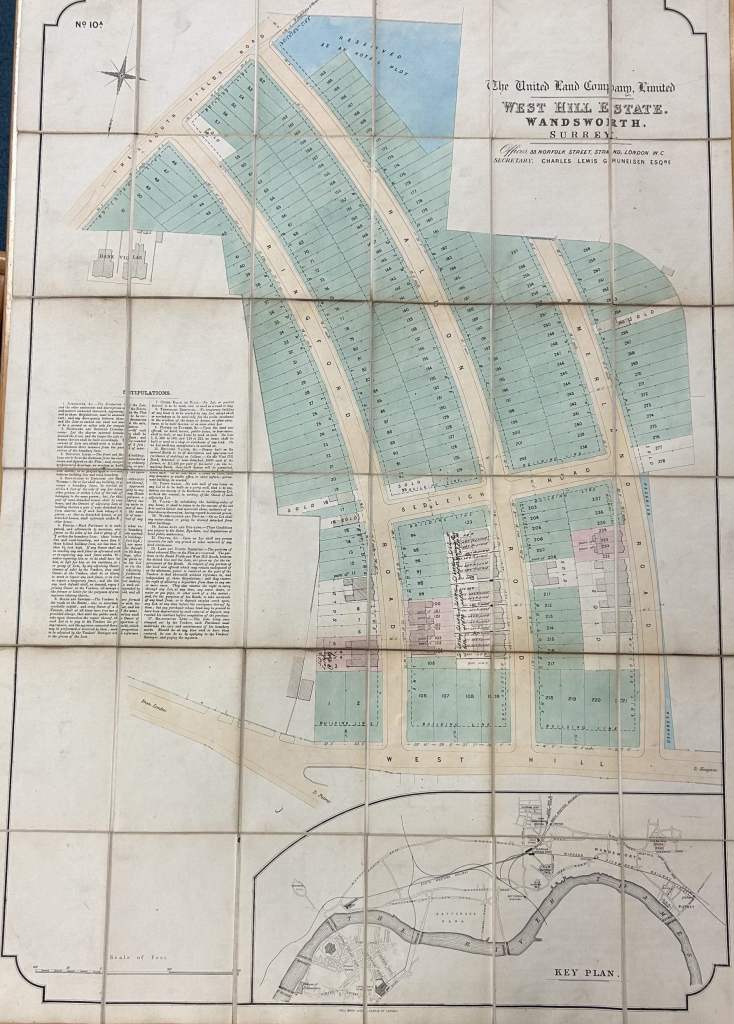
United Land Company Plans for West Hill Estate – with Hotel Plot marked
– undated – Wandsworth
Historical Archives – Deeds/102
In this next version of the plans the hotel plot disappears, to be
replaced with a dead end road with a turning circle – things were a
bit limited by the refusal to allow the construction of the extension to
Southfields Road into Wimbledon Park Road.
It gets stranger still as others, at a later date, apply to extend
Southfields Road to meet with Wimbledon Park Road. This is rejected by
The Wandsworth Board of Works.
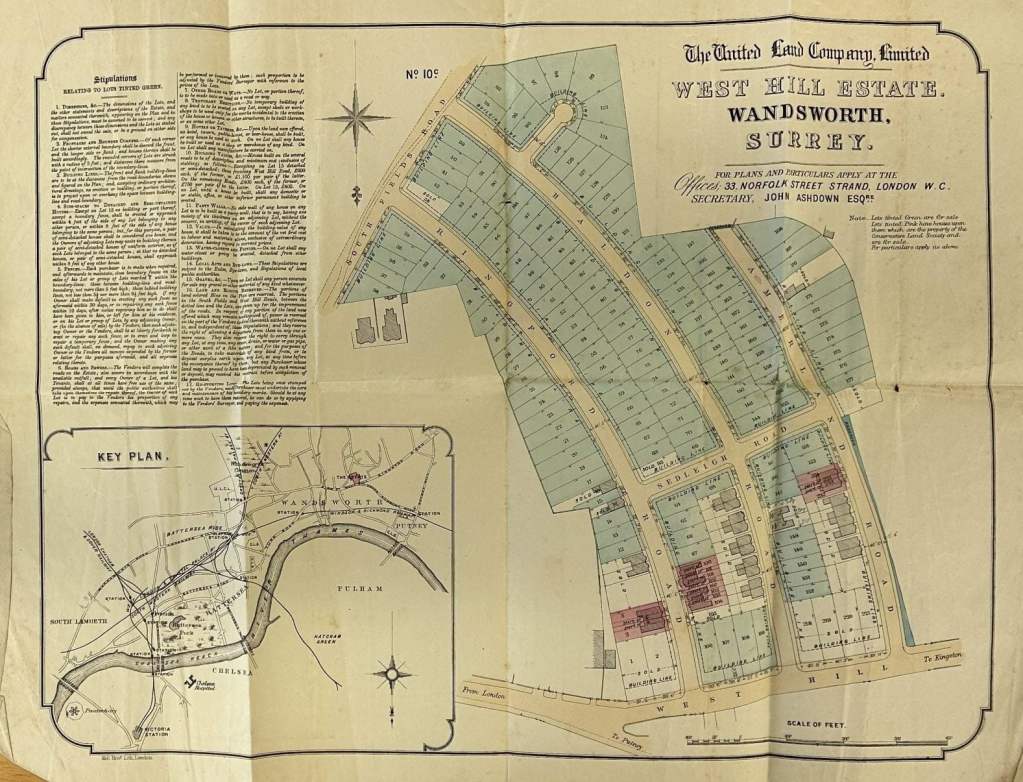
United Land Company Plans for West Hill Estate – without Hotel Plot
– undated – Wandsworth
Historical Archives – HOW/223
Then comes a considerable muddle with what is going on regarding the
hotel and the formation of Jeptha Gardens. The Jephtha Gardens
application is quite a curious application as we can infer that the
hotel scheme had advanced with a proposed access way between Merton Road
and Southfields Road, and an area off of Southfields Road that looks
like it was intended to be the stables or service areas for the proposed
hotel. There is no sign that this scheme ever gained a consent for the
roads to be built hence why the land was probably built on.
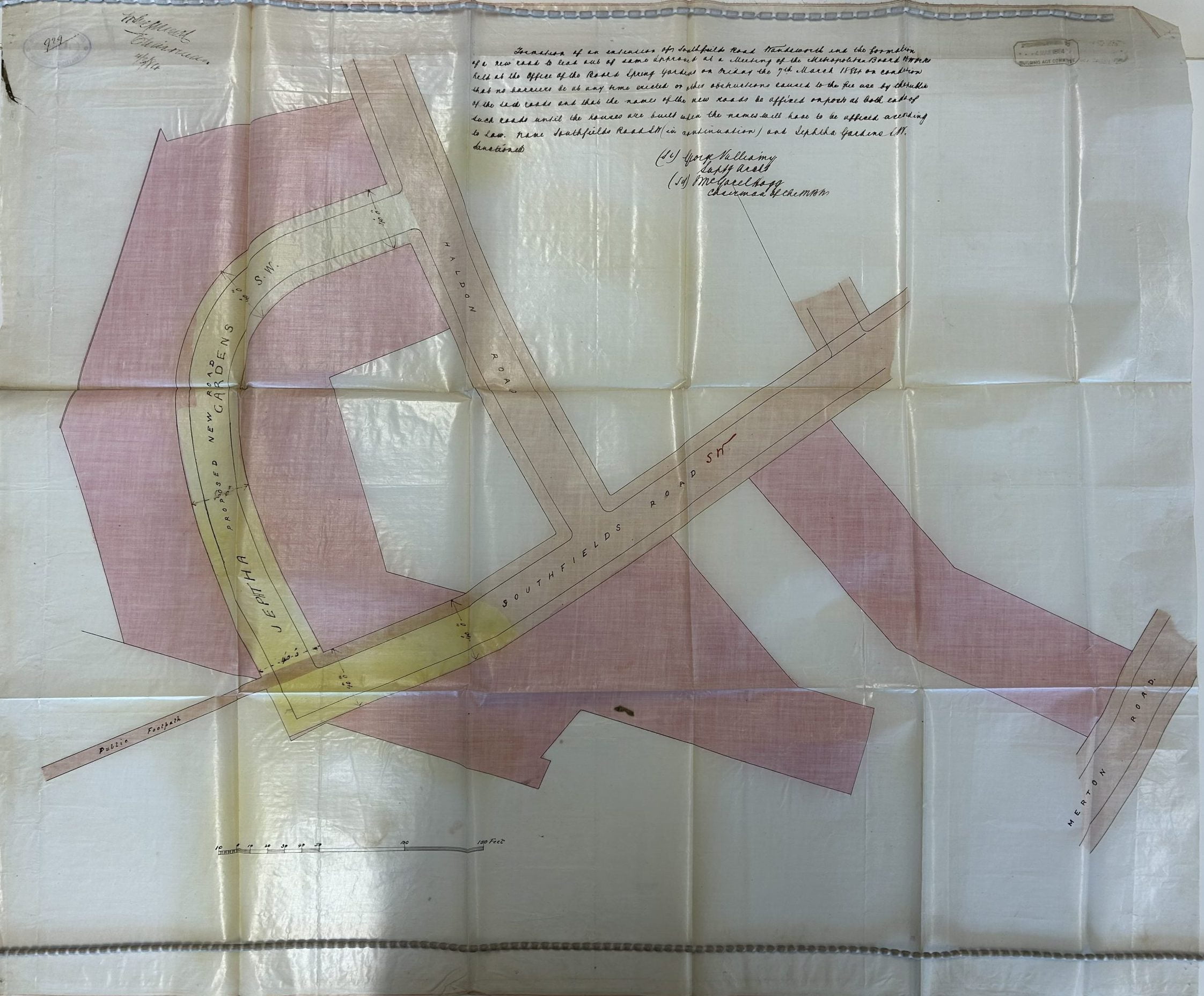
It is quite hard to unpick the ownership of the lands in the Jephtha
Gardens section of the scheme because all of the land marked pink in the
1884 plan below only appears on Land Registry from the 1950’s onward
with no indication as to whom the original owner/developer might have
been.
One possibility is that the lands were leased. This would seem to
indicate that the 99 years lease for the whole plot in pink ran from the
1850’s. This is consistent with what the Finch family were doing along
Merton Road and some deeds from the 1850’s show C. D. Finch as the
landowner. The Finch family was also involved in the development of the
villas alongside Wimbledon Park Road before the junction with West Hill
Road as their name appears on the first sets of deeds so it is quite
plausible but by no means conclusive.
Another explanation which concerns the activities of our friend Mr
Elsdon and the construction of the Bazalgette sewer! As the Bazalgette
sewerage system is gravity drained the possible routes of the sewers are
highly constrained by topography and the costs of the knocking down
existing buildings. What struck us was that the plots between Merton
Road and Southfields Road both nearly obstructed the passage of the new
main relief sewer across the strip of private land. Could it be, we
mused, that Elsdon was actually creating a ‘ransom strip‘? The
ransom strip idea seemed intriguing until we searched the MBW minutes
and found this entry – Elsdon had previous form for claiming for
compensation with regard to the construction of the MBW sewerage system.
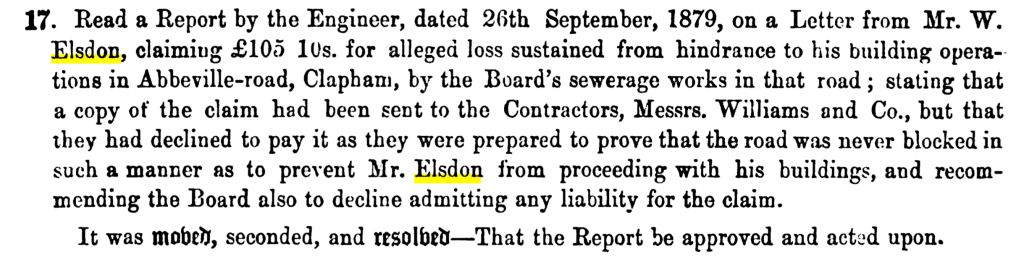 Minutes of Proceedings of the
Metropolitan board of works 26th September 1897 – Elsdon Applies for
compensation in connection with a sewerage scheme. 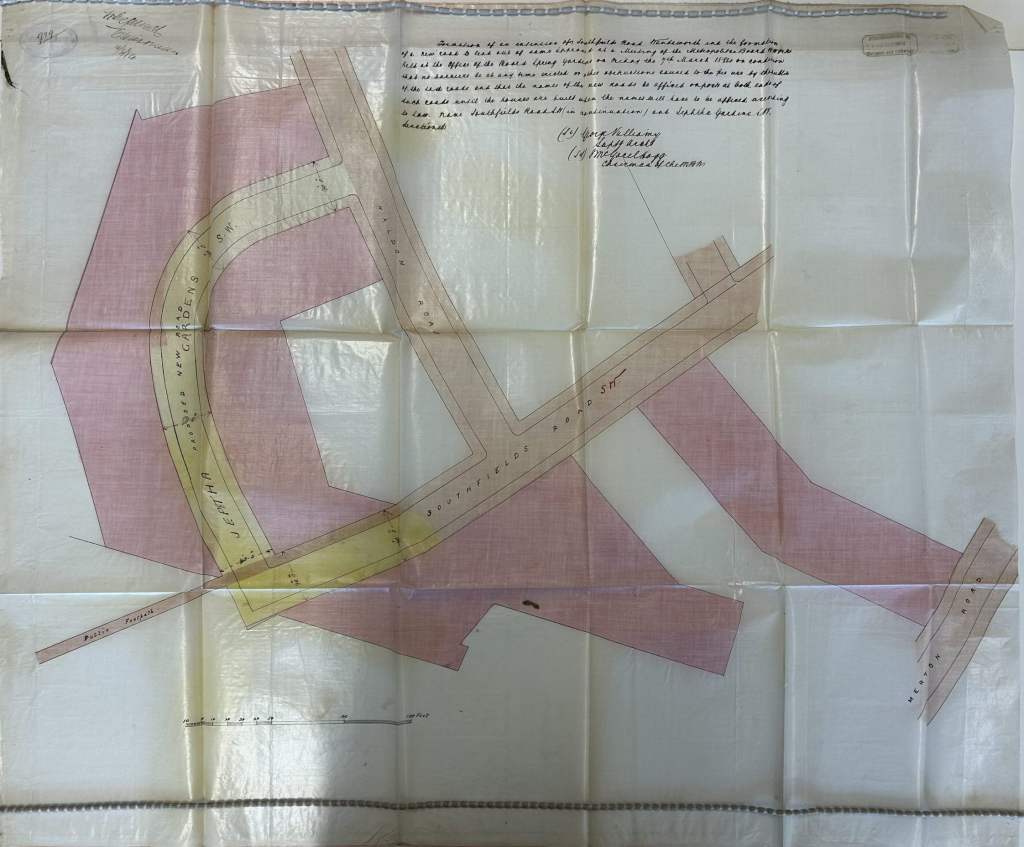
Application for the formation of Jephtha Gardens – showing the
extensions of the demise beyond Southfields Road into the plot between
Southfields and Merton Road – dated 7th March 1884 – London
Metropolitan Archives We are researching if the area of
land in pink were compulsorily purchased from Elsdon. If so the
compensation payments should appear in the MBW series MBW/1990 thru to
MBW/1993 relating to compensation payment or in the series MBW/1993 –
1997 relating to contracts. Something was done: the sewer had to be
built and his antics could not be allowed to get in the way of that. It
is also interesting that on the other side of the Wandle Valley the
plots were sold off shortly after the sewer was completed – this is
clear because it is recorded in the main MBW minutes. Alfred
Heaver also pops up as a builder. Heaver, better known for the
Heaver Estates in Balham and Fulham. 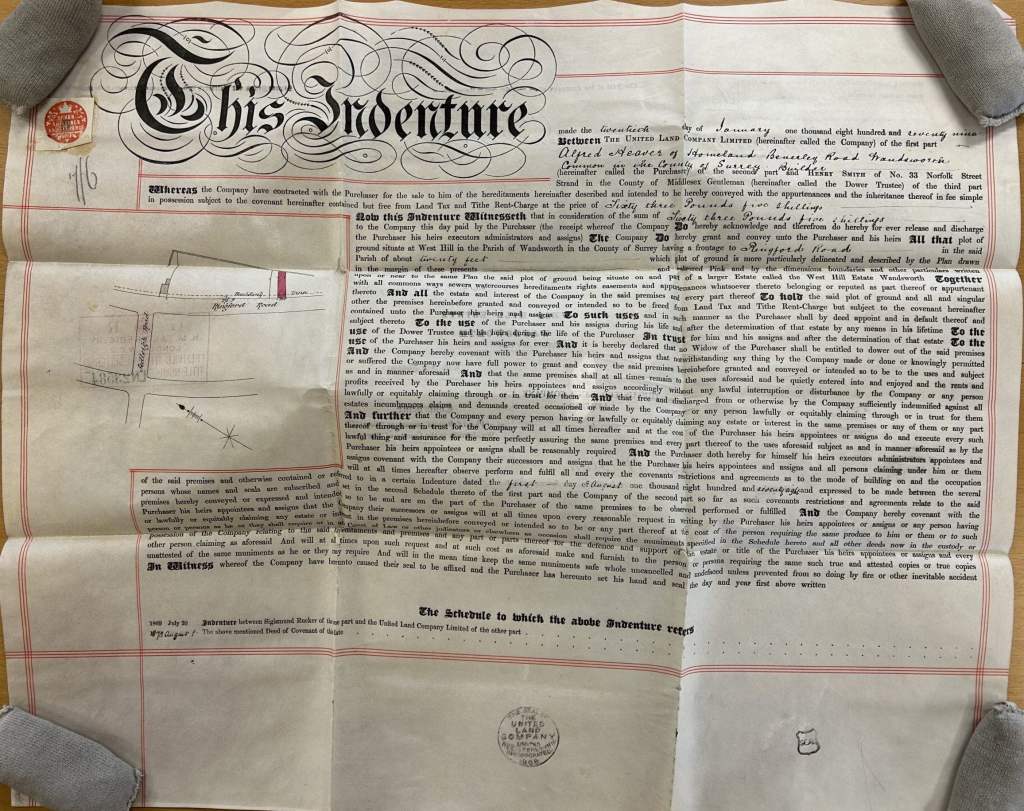 Indenture between
Alfred Heaver and The United Land Company for a parcel of land off
Ringford Road dated 20th Jan 1879 – Wandsworth
Historical Archive – Deeds 3680
Keep
reading – what happens when John Augustus Beaumont dies?
Footnote ¹It is pretty clear that neither the Metropolitan Board of
Works or The Wandsworth Board of Works wanted Southfields Road to
connect to Wimbldeon Park Road as otherwise Southfields Road would
become the main road and not a residential street. Even in the 1880’s
the connection on the start of the A3 and West Hill, by what is now
Wandsworth Police Station, was an issue and having more traffic at the
Merton Road / A3 junction was not seen as a great idea. Bear in mind
that there is a relatively steep gradient at this point and horse drawn
carts and carriages would have struggled with this at the best of times
never mind with the merging of larger volumes of traffic.