

This series of blogs in our From The Archives series is
intended as a resource for schools and local residents who are
interested in researching local history. We are very happy to help
schools with access to relevant materials. However, the images that are
reproduced here should be assumed to be the copyright and may not be
reproduced without licence from the archives and commercial use is
therefore strictly prohibited.
The
West Hill Estate and The Wimbledon Park Estates – Part I
We have divided this part of the blog up into a number of sections by
theme rather than by strict timeline. The
West Hill Estate and The Wimbledon Park Estates – Part I – John
Augustus Beaumont – this page The
money to buy The West Hill and Wimbledon Park Estates – Where did John
Augustus Beaumont obtain it?- Separating fact from fiction – Part II
The
District Line Crossing Wimbledon Park – Part III The
Creation of Wimbldeon Park Road – Part IV The
West Hill Estate Developing Into Mass Housing – Haldon Road &
Surrounding Roads – Part V Epilogue
– Part VI – onto Lady Lane Wimbledon
Park – Through Early Photographs – From Before the Start of the
AELTC Era
John Augustus Beaumont
One man was largely responsible for the development of most of West
Wandsworth and Wimbledon as we know it today. His name was John Augustus
Beaumont. John
Barber Beaumont [1774-1841] – father to John Augustus Beaumont, John
Thomas Barber was born on 21 December 1774 in the parish of Marylebone
in London. He assumed in 1812, for unknown reasons, the additional name
of Beaumont (which was retained by his descendants) and was often known
as “Barber Beaumont”. John Barber Beaumont founded The County Fire
Office, – an insurance company specialising the in the insurance of
country houses. It was built into a very profitable business. John
Barber Beaumont also founded The Beaumont Philosophical Institution in
the East End of London. The Institution was administered by the Beaumont
Trust. In the longer term the Institution was one of the organisations
leading up to the founding of Queen
Mary and Westfield [QMW], University of London, which now has a Barber
Beaumont Chair of Humanities. John Augustus Beaumont [1806-1886] was
a successful insurance magnate and succeeded his father as the Managing
Director of The County Fire Office in 1841. He is often written off, by
some authorities, as a ‘property speculator’ but in reality is the
master planner for the whole area. It was Beaumont and his team that
applied for and set out the shape of the streets and the building plots.
Historically the major local landowner and Lords of various Manors were
the Earls
Spencer and The Duke of
Sutherland. By the 1820’s George
John Spencer, 2nd Earl Spencer was struggling financially By the
time the 2nd Earl Spencer died in 1834 enormous debts had been built up
from running three large houses full blast, the rebuilding of Althorpe,
Lady Lavinia’s lavish entertaining and the 2nd Earl’s mania for
collecting rare books.¹ It fell to John
Charles Spencer, 3rd Earl Spencer to take some hard decisions as to
what, of the very many large houses he owned, could be retained. This
also pertained to lands that needed to be rationalised.
Earl Spencer’s land sales
This was conducted as a series of land sales and auctions between
June 23rd 1845 [£12,990], 30th October 1835 [£32,250], 16th December
1835 [£23,800], 22nd April 1836 [£23,730], July 1836 [£17,690],
26th August 1836 [£17,440], Sale 7 date unspecified [£8,970], 19th
July 1837 [£8,415] giving a total yield of £145,285 excluding the land
deals that he was about to do with John Augustus Beaumont. A good
selection of the auction catalogues are extant in the Northampton County
Records Office [SOX 278-1] – we have only reproduced the surviving
auction plans relevant to Wandsworth.  Plan from Earl
Spencers 16th December 1835 auction. By kind permission of the
Northampton County Records Office [SOX 278-1].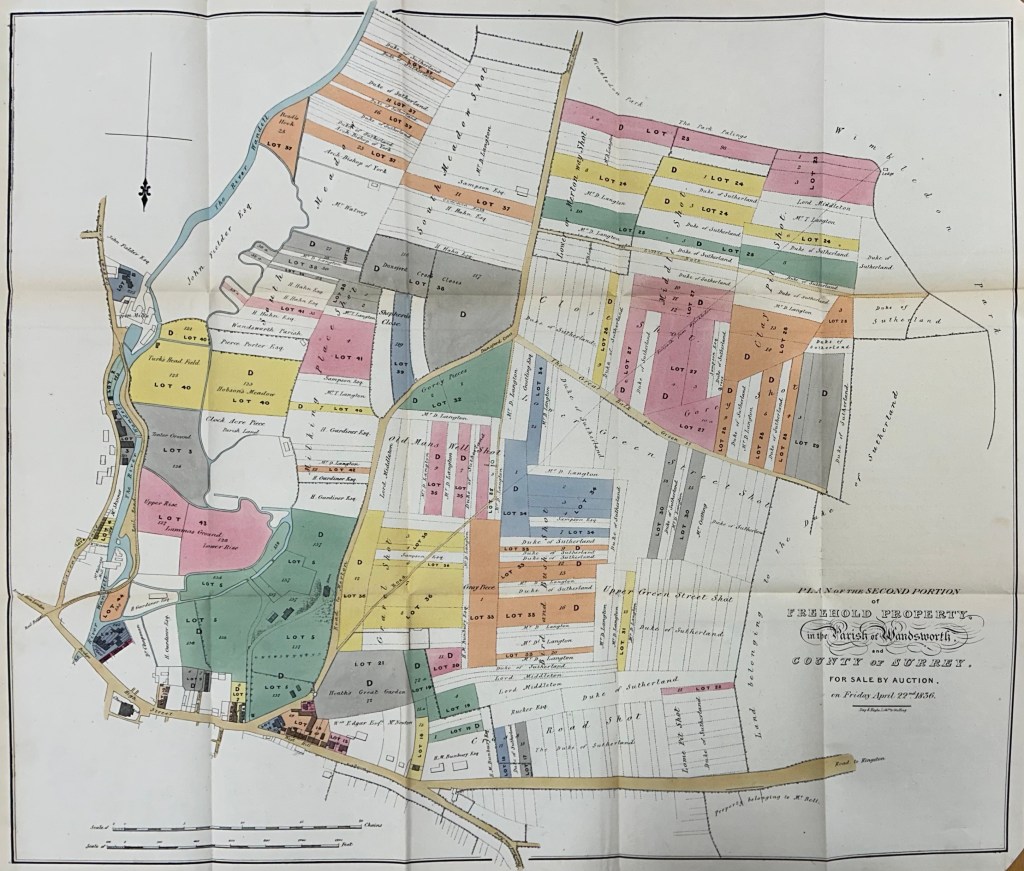
Plan from Earl Spencers 22nd April 1836 auction. By kind permission of
the Northampton County Records Office [SOX 278-1]. Plan from Earl
Spencers 19th July 1837 auction. By kind permission of the Northampton
County Records Office [SOX 278-1].The full auction account
book showing the auction receipts, this tells us exactly to whom and for
how much each parcel of land was sold.

The account book from Earl Spencer’s land auctions between 23rd June
1835 – 19th July 1837. By kind permission of the Northampton County
Records Offic
Beaumont bought some of the lands as a result the major land
auctions [according to a document entitled Earl Spencer & J A
Beaumont Notes for agreement – undated SOX142 Northampton Archives
Service] being lot 30, 31 and 32 although he either bought them through
nominees, so as not to drive the prices up, or bought them privately
after the auction because Beaumont is not listed as the purchaser in the
auction account book above.
Duke of Sutherland’s land
sale
The Duke of Sutherland sold The West Hill Estate on 23rd May 1842 at
auction. The buyer was John Augustus Beaumont. The auction catalogue
and plan are in the Sutherland Collection, in the Staffordshire and
Stoke on Trent Archives Service, where there is also considerable
material on the day to day life of the house. The Duke of Sutherland
banked with Drummonds and there are some banking books extant with the
Sutherland Collection [D593/P/34/2/1-4] which show a deposit of
£40,500 was made by Beaumont to the Duke of Sutherland on 9th August.
We are currently looking to see if there was an earlier deposit payment
of, likely, 10% of the sale price on the day of the auction.² Otherwise
this does not add up to the £45,000 that Beaumont claimed to have paid
for the estate. 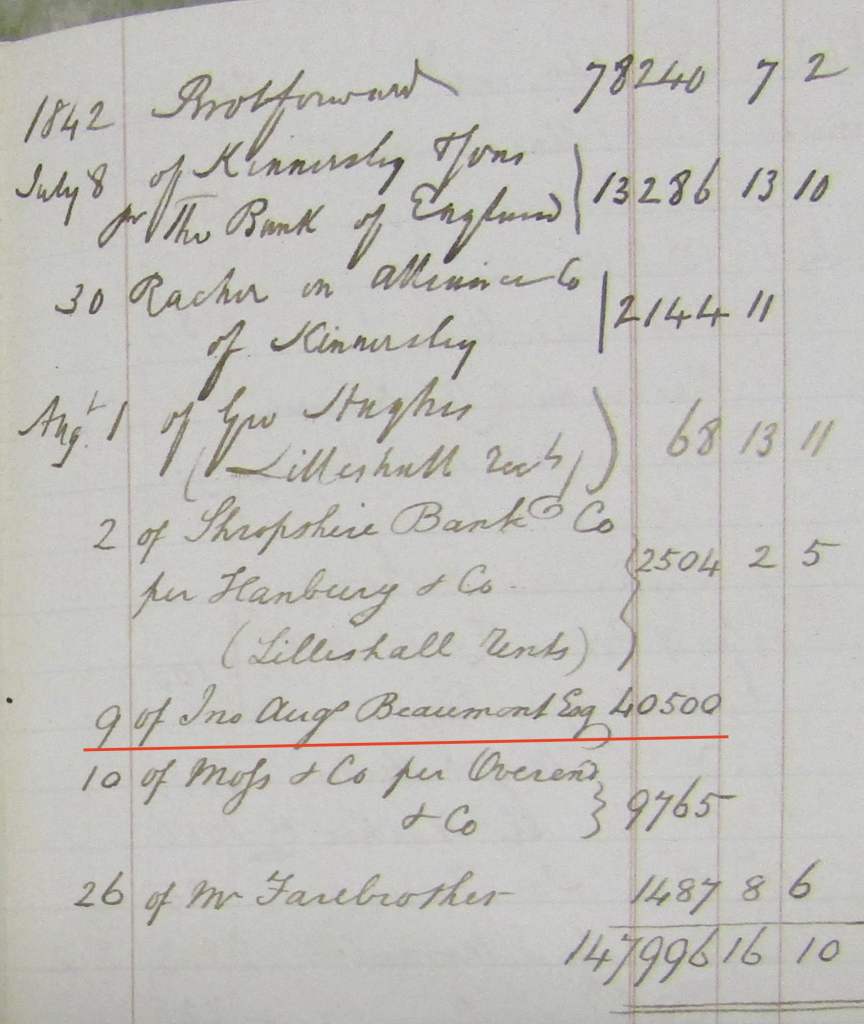 Duke of Sutherland’s banking
book for his Drummonds account for 1842. Showing the deposit of a cheque
for £40,500 on 9th August 1842. By kind permission of Staffordshire
County Archives D593/P/34/2/1-4 Drummonds ultimately became
part of the NatWest Group however The Duke of Sutherlands ledgers for
1842 do not survive.³ The 1842 auction plan of the lands of Melrose
Hall, where Beaumont was to establish himself as he carried on his great
project. Melrose Hall still survives as part of the Royal Hospital for
Neuro-Disability.
Presumably the founders of the hospital bought the hall and site from
Beaumont but this is glossed over in the online
history which simply references Earl Spencer and Capability Brown.
 Sutherland Collection. Staffordshire
and Stoke on Trent Archives Service. Reproduced under limited
licence. The sale particulars of the West Hill Estate and
Melrose Hall [we are trying to obtain a full copy of these].  Sutherland
Collection. Staffordshire and Stoke on Trent Archives Service.
Reproduced under limited licence. Beaumont agreed with Earl
Spencer the purchase a parcel of lands in Wimbledon and Wandsworth in a
Conveyance dated 12th August 1843 entitled “Counterpart – Conveyance in
fee of part of Wimbledon Park and of Lands in Southfields in Wandsworth
Cou[nty] of Surrey”. The purchase price, stated in the Conveyance, was
£14,425 which seems a remarkably small sum for the extent of the lands
involved. 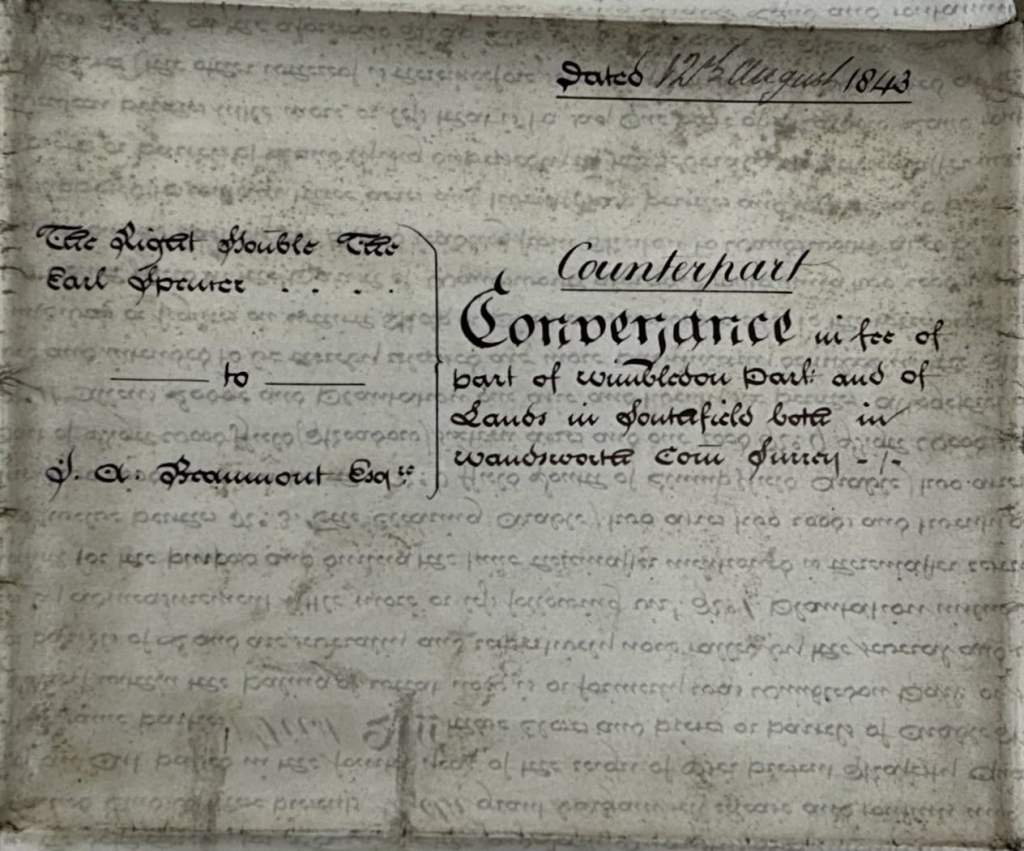
Counterpart Conveyance in fee of part of Wimbledon Park and of Lands
in Southfields both in Wandsworth Cou[nty] Surrey. dated 12th August
1843. By kind permission Northamptonshire Archives Service. SOX142
In 1845/6 Earl Spencer and Beaumont agreed a further purchase of
lands. We can be absolutely certain of the consideration [purchase
monies] and the extent of the lands as the full set of records is
extant. There is also a fascinating head of terms agreement entitled
“Articles of an Agreement made this Eighteenth day of June one
thousand eight hundred and forty five Between The Right Honourable John
Charles earl Spencer of the one part and John Augustus Beaumont of West
Hill Wandsworth in the County of Surrey Esquire of the other part.”
The sum of £80,000 was settled on as the land was parkland and was not
agricultural land. Beaumont therefore got a very good deal on this
building land. 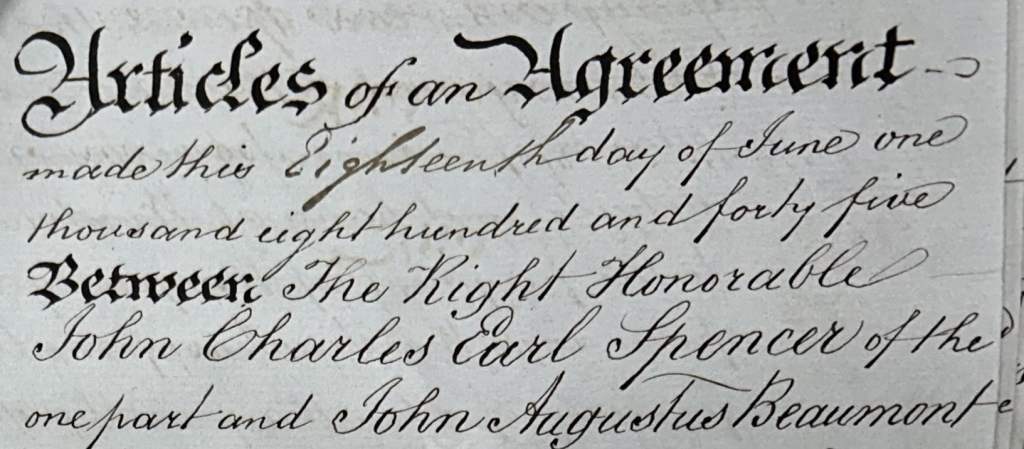
Heads of terms agreement between Earl Spencer and Beaumont for the
purchase of Wimbledon Park. Northamptonshire Archives Service.
SOX142
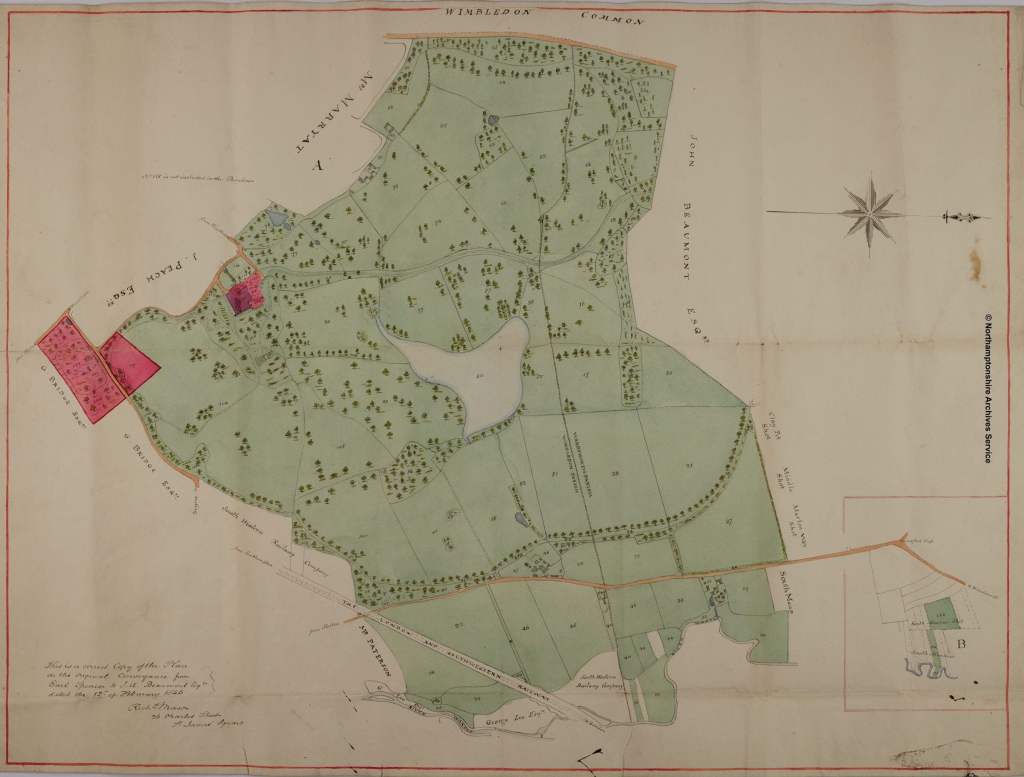
Contemporaneous copy of the deed plan for the sale of Wimbledon Park
from Earl Spencer’s papers. Northamptonshire Archives Service.
SOX142 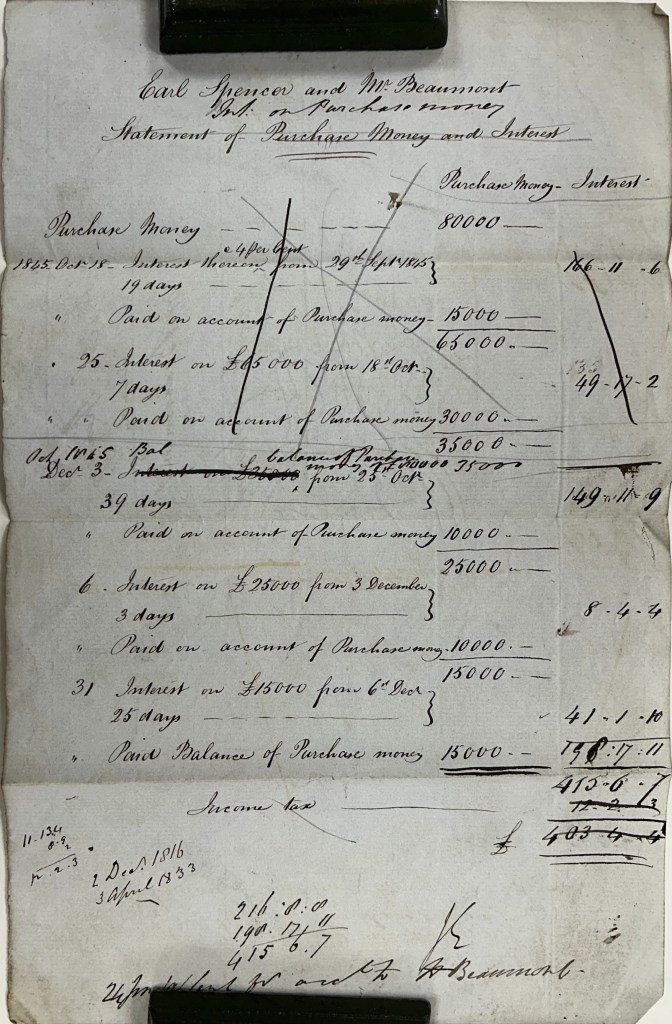 Wimbledon Park –
“Earl Spencer and Mr Beaumont – Statement of Purchase Money and
Interest.” By kind permission of Northamptonshire Archives Service.
SOX142 By the time of the Ordnance Survey Map of 1870 which
was actually surveyed in 1865-7 we can clearly see considerable
development of The Wimbledon Park Estate. Many of the early houses in
the Wimbledon Park development had considerable basement
excavations, as was common at the time for storage, kitchens or
staff quarters. A good selection of original
deeds survives which gives a very good idea of the scale and timing
of the transactions. 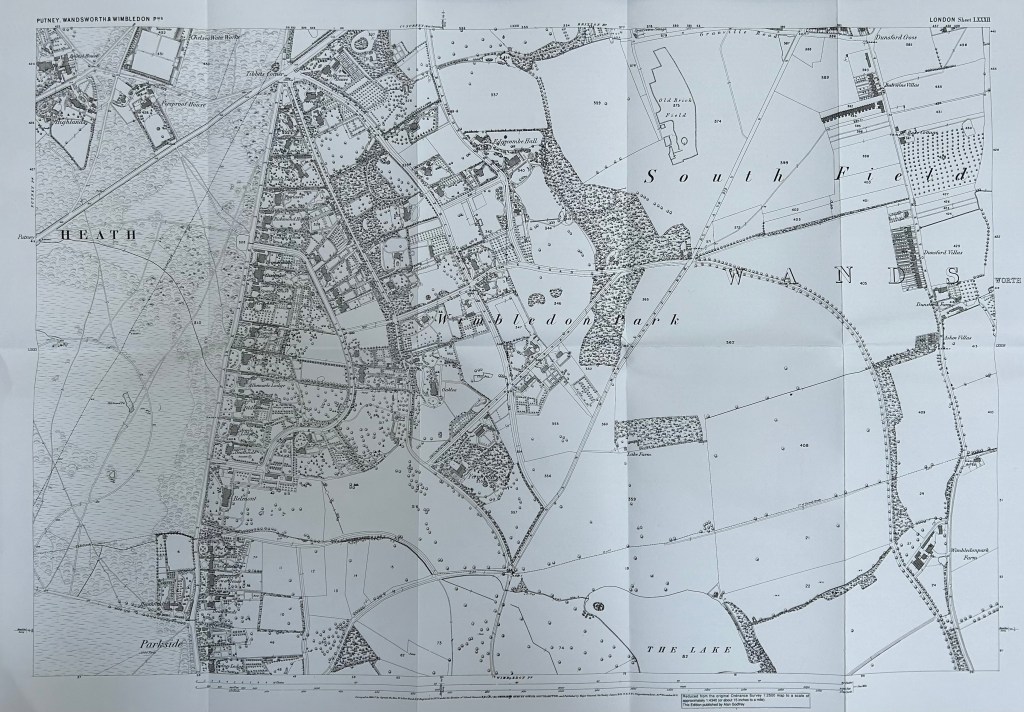
1870 Ordnance Survey Map of Wimbledon Park. The actual survey work was
carried out 1865-7. The early developments of major houses along Park
Side, as it is labelled, is quite clear. In a beautiful, 1879
plan, entitled The Plan Of The Wimbledon Park Estate, we can see the
full extent of the lands that Beaumont bought up. There is considerable
detail shown here including the extent of major tree planting on the
site. We can also see Wimbledon Park Lake before it was modified in a
series of schemes to enhance local surface water drainage. The lands
that formed the later Wimbledon House
Estate, complete with its lake, are marked as belonging to Sir H. W. Peek Bart
and so are the lands that formed the Belvedere House
Estate of the 1900’s.  1879 Plan Of The Wimbledon Park
Estate – showing areas for sale in green and areas that had already been
sold in pink – London
Metropolitan Archives – LMA/MBW/26948. Standen Road is highlighted
as this was found in the folder concerning the application for
permission to form Standen Road. Part of the reason for the interest in
the map is that it is such a beautiful printing: it was produced by a
very specialist firm Vincent
Brooks Day & Son Lith who were the leading printers of the time
and who developed a great many of the special processes used
themselves. Wimbledon Park Road has been created, however The
District Line, as we now know it, is yet to be created as is the
extension of Sutherland Road, that runs alongside the District Line
today. To the East of the plan it is clear that Beaumont had been less
successful with buying up the entirety of the lands and there is clearly
a field where Beaumont had ownership of odd strip but by no means that
whole area. This may well have been because the Wandle valley was highly
industrialised, so Beaumont was less interested in those areas. Beaumont
was keen on sweeping views and the, already by then, highly
industrialised Wandle Valley was a far cry from that paradigm. What the
1879 map does make plain is just what an enormous area John Augustus
Beaumont had succeeded in buying up. This was by no means, the only area
of Wandsworth that he snapped up in the various sales of the
1830-1840’s. Which rather leads to the question ‘where did he get the
money to buy all this land so quickly?’
Continue
reading – Where did John Augustus Beaumont get the money from?
Footnotes ¹In a coincidental wrinkle in a document dated, 31st
March, 1813, document “Report on great tithes and
on those parts of South Field and Wimbledon Common taken into Earl
Spencer’s Park” by John Trumper of Harefield [LMA/A/JM/505] was
prepared for the trustees of John Marshall’s Charity. Clearly there were
some issue and we suspect that this centred around Earl Spencer not
wanting to pay the higher great tithe rates for productive agricultural
land once his ancestors had volitionally turned agricultural land into
parkland. This could well have been the final trigger to the sale of
Wimbledon Park to John Augustus Beaumont – the sheer ongoing costs of
paying tithes as well as upkeep. ² Personal correspondence with
Sunderland Archives 14th December 2023 In terms of account books,
the majority of the financial records we hold relate to the estates,
primarily Trentham of course. There is less information as to the
private accounts of family members. I presume the sale of an estate
would go into a personal account, perhaps a trust. We do have some
personal bank books for the Second Duke for the period, with his bank
Drummonds 1833-1854 (refs D593/P/34/2/1-4). There is also a chance that
something will appear in the correspondence between the Duke and the
Chief Agent, but this is a voluminous series, with monthly bundles each
containing a large number of letters arranged by correspondent – the
Agent usually dealt with estate correspondence and then wrote to the
Duke as necessary. But again the Agent mainly dealt with the estates.
There were also Private Secretaries who conducted personal business, and
we do have some miscellaneous correspondence for the right period
(series D593/Q). ³ Personal correspondence with NatWest Group
Archives 15th December 2023
I’m afraid we don’t hold the accounts for 1842. The customer
account ledgers of Drummonds Bank are complete for the period 1716-1815.
The ledgers continued after 1815 but only survive for every 10th year
thereafter, the remainder having been pulped during the Second World
War.
We do hold accounts for the Duke of Sutherland for 1845 but they
wouldn’t have anything about a transaction from 1842.