

“Lead is invaluable material, acting as weather protection and
providing a major aesthetic for traditional British buildings�
I met with Marcus, a specialist in lead roofing. Marcus’s work
takes him to some of the most prestigious buildings in London. He worked
on the restoration of St James’s Palace, a Tudor building, dating back
to 1531.  Marcus restored a lead roof on project in Kensington
Gate, a Grade II* listed property. OLBC are carrying out the full
house refurbishment. And we require the highest level of
craftsmanship to achieve outstanding results. Lead has been used since
Roman times to cover roofs. Lead roofs feature in Britain’s most
iconic buildings, including Hampton Court, and the Tower of London. Lead
was first mined in 6500 BC in Anataolia. The Romans used lead
extensively for both roofing and plumbing. Unlike other material, lead
doesn’t need protection from corrosion by being painted: it is
protected by its own oxide layer. However, modern acid rain can erode it
faster than in ancient times. A special oil, patination oil, is painted
onto the lead to ensure it doesn’t develop a white streaky surface
effect from oxidation and then subsequent sulphation, caused by the acid
rain. When this white ‘bloom’ effect develops it tends to trap more
acidic material thus accelerating the erosion of the surface.
Surprisingly, underneath the thin oxide film, the lead is bright, shiny
bluish-white and when you scrape it, you see how soft is. It is this
malleability that makes it easy to squeeze or roll into different
shapes. “There is a long tradition of marking
leadwork. Plaques are most likely to be found on country houses or
churches with large areas of lead and are often to be found on rain
water hoppers. Early fire insurance company plaques were often made of
lead marking the houses that were insured.� 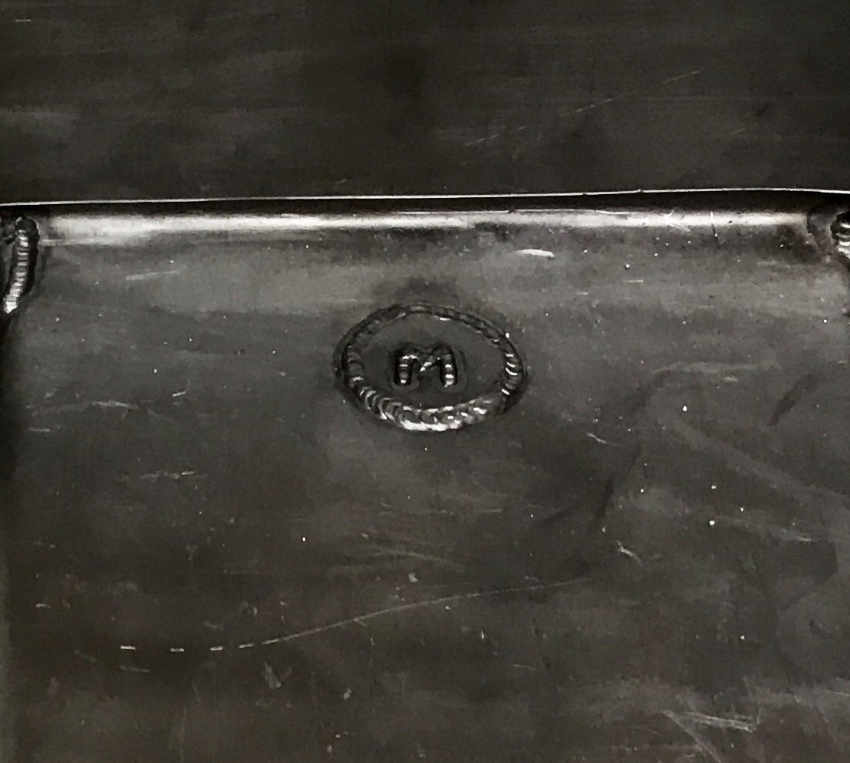 Marcus marks his lead work with a signature
“M� Lesser buildings may still bear the historic of works
– most common are the outlines of hands and feet, often initialled and
dated. How did you become involved in lead roofing? I
learned to burn lead at the age of sixteen alongside my uncle, Mick
Pollington. Mick was gained a reputation throughout London for being the
best lead specialist in town. I struggled to concentrate in school, and
seeing the movement of lead captured my attention. Something malleable
that could be manipulated suited my short attention span. I decided at
an early age that this is something I want to invest my time into.
Do you think there is an element of artistry involved?
Absolutely. The lead work we create outlives us. Investing in a lead
roof leaves a footprint that can be passed on from generation to
generation. “The concept of creating something that will surpass my
own lifetime drives me to reach perfection working on a project.�
Is it just roofing work that you work with lead with?
Generally speaking yes, but many years ago I ended up with leftover lead
sheets from a project, so I decided to cast them into plant pots. I was
happy with the result and created hundreds of units of them. “We ended
up selling them as a display to Moyses Stevens, an old established
florist company at Harrods.� Is there more of a demand for
restoration projects or new lead work? Restoration
work. There are lots of poorly executed jobs that we are called in to
repair. A majority of time we see the lead has been fitted incorrectly,
so it ends up overstressed and splitting. Our job is to salvage it.
What sets apart a poorly executed lead work job to an
exceptional one? A lot of tradesmen claim they are roof
specialists, but it’s instantly clear to see the difference in the
work. Hammer marks, when the lead is shaped, are a big no-go. A
specialist requires an extensive understanding of grading and folds the
lead neatly. Lead roofing is surprisingly mobile as is the timber
structure beneath it. The art is to prevent the lead splitting or
sagging over time. In order to prevent lead from splitting there needs
to be an understanding of how to allow the lead movement and
ventilation. I use copper clips to attach the lead to the structure. We
sometimes fit rubber expansion joins to allow movement between one sheet
and another. Can you explain about why there is so much movement
in lead? The temperature of lead roofs varies depending on
differential between the outdoor and indoor temperatures. Then add the
effect of strong sunlight on a large area of lead: it varies far more
than the outside air temperature and worse you can end up with a massive
recurring temperature cycle through day to night! Can you
explain what you mean by grading? Every sheet has a different
weight, which will be assigned a code. You have to look at the span of
the area the lead is covering and use the right weight (code) of sheets.
Can you explain what lead flashing is? Lead flashing
refers to thin material used to prevent leaks, and is fitted into the
joints between structures of differing materials to allow the water to
be guided away. I would imagine a lot of people put off
restoring the roof in their home, as they feel people can’t see it. Do
you think that roofing work is often neglected? The fact that
is something so far away means that people overlook the potential in
roofing. Roofing can produce incredible results, and in many ways it is
the structure that binds the whole buildings together. There is no point
in working on a full house refurbishment and neglecting the roof. It
gives the building and neglected appearance. Neatly folded lead that has
been coated in oil can transform the exterior appearance of a building.
How does your role interplay with other tradesman on site? I can
imagine you have to work closely with masons. There is a direct
intersection between lead and masonry. We work as a team, and our work
has to compliment each other’s. Trust in each other is required, which
is why the jobs I am recommended for are word-of-mouth. I work
repeatedly with the same network. I need to know that once I have fitted
the lead, that the brickwork surrounding it will compliment the work. I
like the element of collaboration. What is the thing you enjoy
most about your role? I love casting and manipulating the lead.
Sculpting a material, which has so much malleability, allows me to be
creative. I also like that every job is different and requires me to
think laterally. Fitting lead requires us to tailor our work to the
building. “I love being high up, towering over London’s sprouting
architecture.” Working on the roof is like having a private viewing
platform. The city has stunning views to offer, and it allows me to view
London life from another perspective. Can you talk me through
the Kensington Gate project? It was one of the most challenging
jobs of my career. When we arrived at the job we could see the roof had
been butchered over time. The entire roof covering required replacement.
We repaired the roof structure before moving forward with renewing the
hand cut Welsh slates and lead work. I’m really pleased with the
results. As I’m interviewing Marcus, I can see it is hard to keep his
attention. I can see why Marcus works with a material that allows his
mind freedom and flexibility. Marcus is one of many craftsmen
that specialise in heritage buildings on our client projects. Marcus’
experience, combined with the exceptional talent of our team
of interior
designers, architects,
engineers and planning experts allows OLBC to manage your project with
the highest level of care. **We can transform your home, while
remaining sympathetic to its unique historical charm. **Send a
message to one of our experts today to learn more
about how we could work with you. Words and photography by
Emma Coady, Marketing Manager for OLBC
Discuss your project with OLBC
Working on a listed building or a prime London property? Tell us about it.