

“Salvaging old treasures, and giving them a new life, sympathetic to
the surroundings is truly satisfying. Each heritage building has a
story. Part of my role is to allow the story to be heard for generations
to come.”
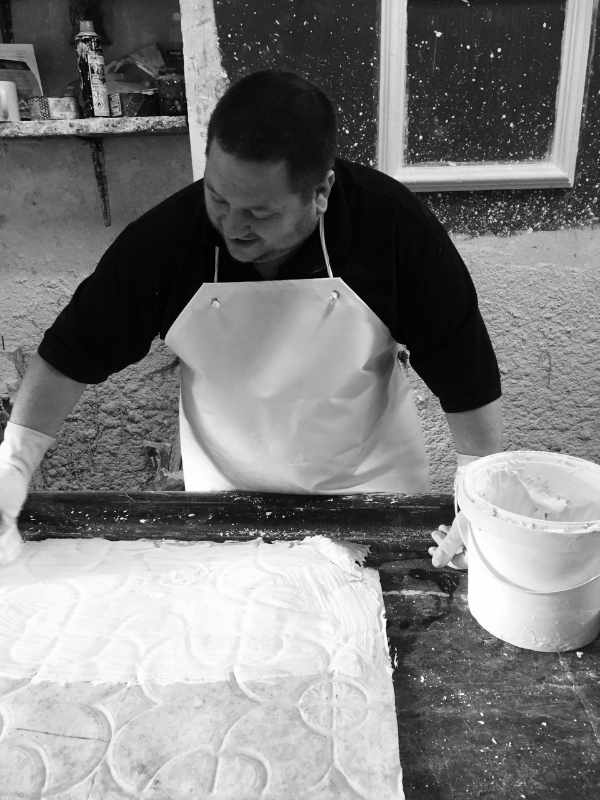 I met Peter, often referred to as “Peter
the Snowman� (due to regularly seen coated in white
plaster). Peter has over 20 years of personal experience and has
worked on a range of projects on behalf of OLBC. Some of the beautiful
plasterwork he has created is showcased in the listed
buildings that The Oxford and London Building
Company have worked on, ranging from mews
houses in Belgravia to substantial
Regency villas around London. As I enter Peter’s modest workshop,
it is easy to see how he acquired his nickname. I am coated in white
after a matter of seconds. As I reach for my pen I see a Le Creuset dish
on a shelf, also coated in a layer of white. What scope of work
does your plasterwork cover? Corbells, cornices, mouldings,
roses, finely embossed wallpaper, and fibreglass mouldings.
Please could you explain what a corbel is? It’s a
structural piece used to carry weight on shelves, walls, arches or
mantelpieces. It works like a bracket, but it can be used to enrich and
add elegant detail to beams ends. We’ve worked on a range of
grand historical buildings; Buckingham Palace is the most recognised
building to date. We produced the cornicing for The Guards Room. The day
of the project I drove a run down Ford Escort estate van, unfortunately
it broke down outside of the front garden! My car was the first
to ever be parked in the garden. As you can imagine, a battered Ford
Escort estate didn’t fit in the surroundings very well!
What project are you working on currently? Recently
I have just finished working on a grade one listed castle owned by Lady
Campbell. Mary Shelly, who wrote Frankenstein once, lived there. We
restored the ceiling in the dining room. It was a particularly
challenging job, because the ceiling bowed inwards, therefore we broke
the cornice run into three, and fit them together to match the irregular
line of the ceiling. I saw stucco wasn’t on your website?
Is that because there isn’t a demand for it? We do create
stucco, but not frequently. Personally, I find that clients are put off
by the high cost. To create stucco the materials that we use are
jesemite and fibregem. Customers don’t always appreciate how expensive
it is to produce. I heard that animal hair is used in
plastering? Is that true? Yes, traditionally horsehair is
used to bind the materials together. We used to get our horsehair from
the police station next door in Wandsworth, which used to be one of the
biggest police stables in Britain. Traditionally, in the eighteen
hundred’s, cornice specialists threw the horsehair up in the air on
site to separate it. It’s rather spectacular to see, and it’s
incredible that these cornices still exist today. Also, Ox hair
was once traditionally used. Now we use hessian mesh, which is produced
from the plant. We ship it from India, however every time they strike we
are left without it, which can be problematic.  How did you learn your craft? My
brother, Mark trained to become a specialist in corning. As a young man
I spent weekends with him, learning the craft. Eventually we decided to
set up a business together. Mark then left to move outside of London and
I now continue. Who were your mentors along the way? Was
there anybody in particular that inspired you? A gentleman
named Mack, who has since retired, has been a great source of
inspiration throughout my career. Kindly he passed onto me my handbook
“Plastering, Plain and decorative by Millar�. It’s well known
within the plasterwork trade as the ‘bible’. 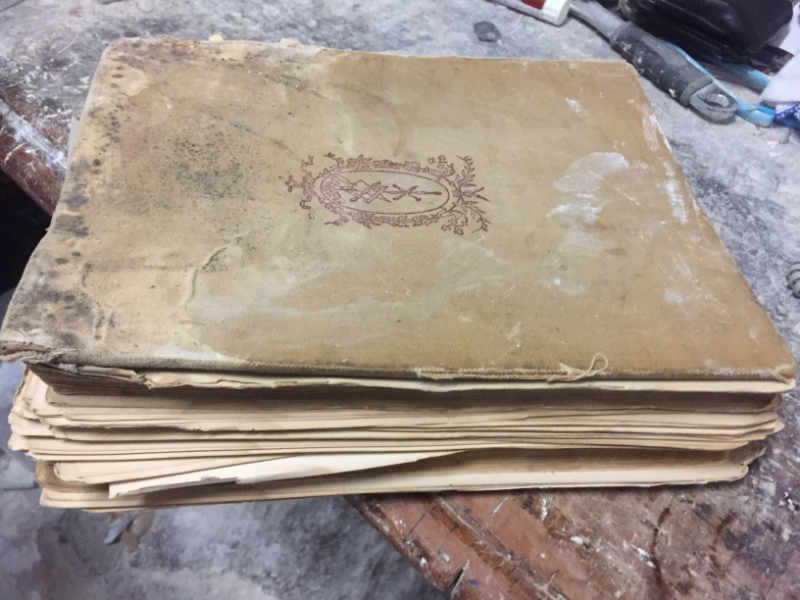 How do the
designs range? What is your favourite design and where does it
originate? Petworth house is a particularly impressive
heritage building. I personally love the simplicity of a cornice with
minimal detail, and a strong structural look, with severe lines. It
looks very effective when the cornice creates a dark shadow underneath,
adding drama in an elegant and understated way. It is constructed using
a wooden lath, which looks similar to a fine wooden ruler, plaster, wood
and lava. How do traditional to modern techniques
vary? Traditionally all work was carried out on-site and
the cornices were created in situ. Now, unless you are creating the
cornices in situ, which are only done to replicate very special effects,
the work is carried out in the workshop. What do you enjoy
most about your job? I like that the role is varied, and
constantly challenging. You never stop learning on the job; every
building and cornice is different. If a cornice is badly damaged, it can
be like unpicking a jigsaw in order to re-build it again that requires
patience. It can be very demanding physically too. A lot of
craftsman end up with tennis elbows, or frozen shoulders.
Sometimes it’s frustrating when customers demand for odd requests.
I once had to reverse a cornice, and thread LED lights through it. It
goes against my work ethos, but occasionally I have to resign my
personal ideas and fulfil customer’s requests, no matter how left
field they may seem. Is all of your work in
Britain? No, we work internationally too. We flew cornicing
designs to Verbier for a large duplex, and often have special requests
overseas. Do you think there is a future for craft
businesses? *Cornicing will never be able to be replaced by a
computer, because everything needs to be handmade. It’s satisfying to
know that we work we create has a personal element to it. I think that
can be said for all craftsmanship. * I work with a gentleman who is
in his late sixties, and he partners particularly well with a young
member of our team, passing on his knowledge, whilst the younger
apprentice has the physical strength. I cherish the idea of passing
family skills on and leaving a legacy behind me, so naturally I was
thrilled that my son wanted to learn the craft, although, he prefers
plain to decorative cornicing. *It may surprise you to know that
trade is full of prima donna’s! We support each other locally, and
share our knowledge amongst ourselves. It’s most helpful to have a
network when we need a problem solving. No job is straightforward; we
need a strategy to ensure we create a piece with minimal damage in the
most efficient way. * Do you have decorative plasterwork in
your own home? Yes, actually I created a dome roof for
our bathroom, which I hand painted myself. It’s very relaxing to look
up into a blue sky and clouds when taking a bath. What is
the most impressive plasterwork you have seen worldwide? I
think that Britain has some of the most impressive buildings worldwide.
The castles our ancestors built in England and Scotland are glorious. We
need to ensure we treasure these assets. Do you often have
the opportunity to use an artistic licence in plastering?
Yes, in the sense that we can advise our customers. Most of the time
they will listen which is rewarding. It breaks my heart to create a
cornice that isn’t sympathetic to its surroundings. My role
is creating something that blends in seamlessly, whilst creating an
impact. It’s a difficult balance to get right. Salvaging old
treasures, and giving them a new life, sympathetic to the surroundings
is truly satisfying. Each heritage building has a story and part of my
role is to allow the story to be heard for generations to come.
Around the workshop Peter exhibits a display of some decorative designs,
which he explains is composed of something known as “composition
mould�. When I ask him what this consists of, he raises his eyebrows
laughing, and explains that composition consists of a secret recipe that
has remained a secret for hundreds of years, only known a very knightly
knit group know about it. When I ask why they wouldn’t share their
knowledge, he explains that it allows the specialist an extra string to
their bow. We have been chatting for over an hour, and I find him most
hospitable. It’s no wonder that Peter has managed to create a network
of local craftsman that he can turn to in a plasterwork crisis for
advice. Peter the Snowman, lived up to his nickname: friendly, genuine,
and coated in white. Peter’s experience, combined with the exceptional
talent of our team of interior
designers, and craftsmen, makes our projects as efficient and
straight-forward as possible, allowing us to transform your home, while
remaining sympathetic to its unique historical charm. Send a message to one of our
experts today to learn more about how we could work with you.
Discuss your project with OLBC
Working on a listed building or a prime London property? Tell us about it.