


” I love anything made with integrity. Something bespoke,
where the product has carefully thought out and designed to be
appreciated for years to come�
I met with Katharina, a Specialist in Finishes and Interior
Restoration to find out how she became a specialist in her craft.
Katharina restored the grand cornicing in the Kensington Gate Project on
behalf of OLBC. Katharina suggested that we meet for our coffee at a
vintage clothes shop. Immediately she is drawn to a glamorous vintage
dress. Already, I am starting to understand how she has ended up working
with heritage buildings Would you say your interest in
historical buildings extends to all aspects of your life? I
love anything made with integrity. Something bespoke, where the product
has carefully thought out and designed to be appreciated for years to
come. I love bespoke clothes, because it provides you with the
opportunity to wear your art. What does the scope of work
entails as a freelancer in specialist finishes? I
specialise in gilding and French polishing, including Verre Englomise, a
technique of gilding onto glass that I hand paint intricate designs
over. What do you enjoy about your job? When I
start something starts off unsatisfactory and messy, and I transform it
into something beautiful, that will be enjoyed by the owners for many
years to come. I also like the sense of starting something and
completing it before I move onto a new project, unlike many other
careers. How did you learn your craft? Well,
my grandfather was a sculptor artist from Vienna, so his legacy has been
passed down the family. However; it suits my personality to work in
craft. I wouldn’t like the pressure of having to create something to
earn a living. I trained at London Guildhall, where we learned
a range of crafts from mould making, metal, wood, and science. It may
surprise you to know understanding chemistry, is an important part of
the job. That surprises me, how does chemistry play a
role? When I work on cornicing it with involve using
noxious substances to remove the original paint using sodium hydroxide,
which can be damaging to the skin and eyes. I wear protected clothing
but once I have finished I have to ensure the cornicing is neutralised
so the alkali does not react with any new paint applied to the surface.
To neutralise the high levels of alkalinity, I spray a mild acid
solution on the surface in small doses until it has been neutralised. I
test this with pH paper at every step. Once the paper has turned green,
it means that the surface is now neutral, and than I can be sure the
area is safe to paint over. After you completed your
degree, how did you end up specialising in cornicing and
ceilings? First of all, it took an internship in Amsterdam,
where I worked in Amsterdam’s historical museum, Museum Willet-Holthuysen. I worked
in a beautiful townhouse that was handed down from a benefactor. I fell
in love with the beautiful frescos’. After that, I worked on a
furniture projects at Adam House, which is based in Mansfield Street,
which backdates to 1783. I then fell into work on ceilings on
that project, although it was on a small scale. After this job I started
working on ceilings on a much grander scale. What is the
proudest moment in your career to date? I feel proud every
time I complete a job. What is the most challenging part of
your role? Working within short time frames, the job can it
can be quite pressurised which results in me working twelve hour days.
I try and pre-empt what difficulties could arise before I start a job.
For example I try and assess the extent of the damage. Fortunately
working in Kensington Gate, the cornicing wasn’t too damaged. There
was a section in the living room, where cement poured over it as a quick
fix, but fortunately the area was relatively small. It was an enormous
job to complete the first phase in three days. The job requires a lot of
patience. I am often working with my hands above my head from eight in
the morning and I can be working until midnight. I certainly won’t be
cursed with bingo wings anytime soon! Is it a struggle to
work without daylight? I will use specialist lights and
halogen bulbs to lights the area, however I have to work in daylight if
I am colour matching. What is your favourite
building? I love the interiors from the Tudor period. I
love the darkness and intricate detail used. That said; I equally love
the lightness of colonial Dutch houses, with large windows in narrow
houses. Do you find out interesting stories about the
buildings you have been working in? I often only find out
what the owners know, so I have to detect what is already there
physically. I have to go on a treasure hunt and investigate, using my
peripheral senses to detect the missing pieces. Sometimes a
historical consultant comes in. I often investigate what techniques have
been used and replicate them. There are rows of terraces on Telegraph
Hill, dating back to the 1880’s where the owners chose their interior
features from a pattern book. The pattern book gave them choices, which
they mixed and matched. Each home has a different combination of
details, depending on the choice of the owner from that period in time;
I love that personal touches have survived over time. What
skills do you need for your job? Tenacity and patience.
Most importantly, you need a burning passion for interiors
and architecture.
Anticipation is key to executing the job within a time frame. I try and
build a story of what I might find before I arrive on site.
 Can you talk me through what process you used when
working with the gilding in Kensington gate? The first phase
would involve stripping all of the paint applied since the first ever
application. Once years of paint have built up, the original design is
completely lost. It does sadden me slightly that despite the British
strong sense of heritage, there are still time where owners are happy to
depart from the original features, and I have known cornicing to be
thrown in a skip! There were layers and layers of modern polymeric
paint; I delicately remove this using Sodium Hydroxide. Underneath this
is distemper paint, based on milk protein that has a chalky finish. This
is then washed with small amounts of water, which softens it, and then I
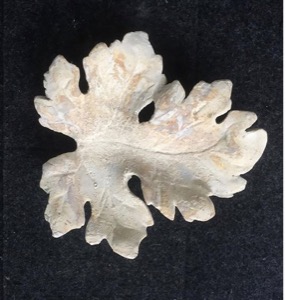
carefully pick it out using sculpting tools. The next stage is to
restore the existing cornicing, and to fill in the gaps by recreating
sections or replacing all of the missing detail. Where I need to
recreate sections using original details I replicate them by creating a
silicone mould, and then remould them in sections, these are sometimes
referred to squeezes in jargon.  How much time does it take you to complete
each stage of the work? With a wide cornice I usually work
on a metre per day. With a narrower one, I can get through two/three
meters per day. I require a day of preparation before I begin to
protect all of the surfaces, and day afterwards for cleaning. After
Katharina showed me the images of the cornicing after she has finished
stripping off the paint, she mentions that recently there has been a
trend in leaving the cornicing unfinished, leaving the intricate layers
to be appreciated in its natural form. It crosses my mind, that the
clients that choose to opt for a raw finish must appreciate detail to
degree that Katharina does… At the end of the interview, her tall
figures fades into the distance, and I sense that she is type of person
that walks down the street, with her eyes wide open, appreciating,
learning, evolving…. Words and photography by Emma Coady, Marketing
Manager for OLBC Katharina is just one of the many specialists that work
on OLBC projects. Learn more about our unparalleled architectural
experience and planning services or get in touch to discuss the
unique specifications of your dream build.
Discuss your project with OLBC
Working on a listed building or a prime London property? Tell us about it.